Showing posts with label spirituality. Show all posts

2.16.2014

Salt | Light | Law

Message Version.
Matthew 5:13-20
13 “Let me tell you why you are here. You’re here to be salt-seasoning that brings out the God-flavors of this earth. If you lose your saltiness, how will people taste godliness? You’ve lost your usefulness and will end up in the garbage.
14-16 “Here’s another way to put it: You’re here to be light, bringing out the God-colors in the world. God is not a secret to be kept. We’re going public with this, as public as a city on a hill. If I make you light-bearers, you don’t think I’m going to hide you under a bucket, do you? I’m putting you on a light stand. Now that I’ve put you there on a hilltop, on a light stand—shine! Keep open house; be generous with your lives. By opening up to others, you’ll prompt people to open up with God, this generous Father in heaven.
17-18 “Don’t suppose for a minute that I have come to demolish the Scriptures—either God’s Law or the Prophets. I’m not here to demolish but to complete. I am going to put it all together, pull it all together in a vast panorama. God’s Law is more real and lasting than the stars in the sky and the ground at your feet. Long after stars burn out and earth wears out, God’s Law will be alive and working.
19-20 “Trivialize even the smallest item in God’s Law and you will only have trivialized yourself. But take it seriously, show the way for others, and you will find honor in the kingdom. Unless you do far better than the Pharisees in the matters of right living, you won’t know the first thing about entering the kingdom.
____________________________
What does godliness taste like? That’s what I thought while I was mulling through this passage this week. I had a delicious lunch with some friends at a Cuban restaurant.  Does God taste like fried plantains? I also cooked this really delicious vegan meal a few nights ago with beautifully green broccoli, fluffy couscous, and roasted squash. Does God taste like fresh vegetables and wholesome grains? “Let me tell you why you are here,” Matthew says, “To be salt-seasoning that brings out the God-flavors of this earth.”
Another way to think about it, we are hear to bring out the God-colors in the world. To be  light. All the time we say and sing that Jesus is the light of the world. But here it says that we are the light of the world. Do you reflect the colors of God? I don’t know about you, but in this bleak white winter blanket that is freezing our ground, I miss the summer and spring and fall God-colors. But that is outside. and our food. what about in here? in us?
What does God taste like and look like--in us as individuals created in God’s image, but also as a people committed to following God’s law? Tastiness and light. What do we make of this?  
Then we have this whole third section that points us to Judaic Law, the Torah. The Torah is the first five books of the Bible, say them with me if you can: Genesis, Exodus, Leviticus, Numbers, Deuteronomy. If you did it in order you get extra points. Jesus makes clear here, He is not interested in starting a new religion. 
Jesus is Jewish. Matthew, the author of this book, is an incredibly devout Jew. Neither Matthew or his understanding of Jesus lead them to a new Law. Jesus was not to destroy Torah. He loved it. It was his history. His identity. His understanding of God and how he related to God. And yet, he knew that all Jews were waiting on something, or someone, the Messiah, to set them free. 
So here Jesus is. The embodiment of everything that a devout Jew holds near, telling people that they are the salt of the earth and the light of the world. In other words, anyone can be salty or well lit. 
Do you realize that Jesus was not trying to start a new religion. It it unfortunate that everything Jewish in our Bibles is on the left “The Old Testament,” and everything Christian is on the right, “The New Testament”.
 We approach it as Jewish vs. Jesus. Or Jewish then Jesus. But Matthew and Jesus saw it differently. Jesus was the fulfillment of Torah. 
He wanted to complete Torah, not replace it. He was here to lead the most righteous, devout group of people Palestine had ever seen. They were going to transform the world. 
This is important for us today. As we sit here in a church on Taylor Blvd. on the Southside of Louisville, Kentucky in the United States two thousand years after the fact. It is important for two reasons. First, we are the Gentiles that were eventually included in this new religion. As the Jesus movement grew and as Jewish disciples, especially Peter and Paul and Barnabas, as they debated about whether or not the new converts needed to follow Torah, they eventually found ways to include those outside the Jewish faith. So, it is a gift that we are said to be salty and lighted too. 
Do you consider yourselves as well lit as Jesus? Paul tells us that our bodies are temples. Jesus says later that God is the vine and we are the branches...entangled together in profound ways. These are tangible images that point to mystical concepts. I’ll talk more about this in a minute.
But I said understanding that JEsus was not trying to start a new religion is important for two reasons. When Jesus fulfills the Torah, the Judaic Law, I believe he says, “individual piety is no longer enough. Now that I am here and helping you to see God more closely, it is time that your beliefs inform your actions.” Ethics are as important as doctrine. To be salty, to shine on a hill is to live like God would live. To help others taste godliness and see God-colors, the people who know this taste and light must live in ways that perpetuate it.
This is probably not the first time you are going to hear me talk about this. Yesterday I attended an all-day retreat at the Passionist Earth and Spirit Center. I am in a class with several others who want to learn the discipline of meditation. As we experimented with the early stages of trying to tame the mind through stillness and quiet, our teacher, a long-time meditator and Catholic priest, said something that made my inner light shine. 
In an effort to encourage our novice attempts to still the mind, he affirmed that it is natural for the mind to wander. “Focus on your breathing,” he says. Let the thoughts come and then just as quickly let them go and refocus on your breath. “The goal of meditation is not to be a good meditator. The goal is to be a good person.” As we practiced turning our attention inward, to the center of the body, the abdomen rising and falling with each breath, we ended each session with the sound of the gong three times. The first time is to recenter one’s self and remember our breath in case the mind had wandered. The second gong tells you to focus on just one relationship. One person to whom you wish peace and wholeness or forgiveness or warmth. One person who needs compassion or joy. Then as the third gong reverberates you slowly open your eyes, ending the session.  
Meditation is not about stillness and quiet for the sake of stillness and quiet. It is about tapping in to the light of God that burns within each us. When we train ourselves to recognize it and make room for it, we are able to live like Jesus was teaching in this sermon. Jesus is saying, “Being salty is not just about preserving good things like Torah. Shining bright is not just about light. It’s about being a good person and sharing those gifts with others. This is the fulfillment of God’s law.” 
When the taste and colors of God shine from our being, our actions and thoughts align more fully with God’s compassion for the world. Jesus is completing the Law each time we let our light shine. Jesus embodies this saltiness and light as he teaches about the Law. 
And because this light is in each of us, the Law continues to find completeness when we stop living for ourselves and start offering compassion. Compassion is certainly a color of God. 
Let’s think for a moment ways that we can be salty and light-bearing. Like our Godspell song sang this morning, “The tallest candlestick ain’t much good without a wick.” How might we live as people whose wicks are burning brightly? 
Well, first, we need to be aware of where the light of God needs to shine. Of where there are people groups who do not know anything about the salty characteristics of God’s flavor. In the headlines this week there has been the Keystone Pipeline XL debate along with stories about the poor villages surrounding Sochi, Russia. Victims of the 50 Billion dollar expansion as construction waste is dumped on their land in the middle of the night.
The ways we destruct the earth, are ways for how we destruct ourselves, depleting our salt levels and placing bushels over our lights. The toxic chemicals we dump into our rivers and atmosphere, we eventually ingest back into our own bodies. They are chemicals that breed cancer, promote infertility, and murk our lungs so that chronic conditions like asthma are said to be normal. 
When we are looking for the taste and light of God, is this all there is to find? Also in the news this week we see people trying to help others shine. You see, we must advocate for salt and light in places that are bland and dark. I see people like Nicholas Kristof working to do this. He is a journalist devoted to the education and liberation of women across the globe. He published Dylan Farrow’s letter about the sexual abuse she sustained from her adopted father, Woody Allen. The allegations are rampant about how Farrow’s famous mother Mia Farrow convinced her of this untruth and planted lies in her young mind about what she remembers as a seven-year-old girl. To the opposite, Allen has put forth his own statement of innocence. Regardless of who or what we believe, the fact remains that worldwide millions of women are subjected to rape and domestic violence and other forms of abuse because they live in patriarchal societies. And when the abuse is reported, words like “allegation” precede any statement about what happened. alleged abuse. alleged rape. alleged affair. Women are subjected and demonized because they are not understood as light-bearing children of God. It is alleged.
Not so with Jesus. Jesus invites us with this message about salt and light and law to join his mission. We are to protect those caught in systems where God’s light does not shine. And what happens when we do this? What happens when we allow people into our homes who need a place to sleep and two months turns in to two years? What happens when we go out of our way to be sustainable during fellowship hour? What happens when we send care packages to a US platoon? What happens when we lobby state and federal legislators for bills that protect the marginalized people in our country? What happens when we rally on behalf of those whose wicks have been cut off? 
When we wake-up to our own light, our own connectedness to God and God’s Law, we do not need to hold so tightly to our grudges. We are able to let go of hurts. Our own temptations fade as we realize more fully that the kingdom of heaven is inside each of us. Our pride dismantles and grace abounds as he realize the light burns fuller when we uncover the light in others. 
Those of us who freely recognize our light, are able to help others trapped under systemic bushels of tyranny. This is experiencing the totality of God’s Law. 
Jesus knew this, and he wanted his followers to understand it. It is why he said he is here to fulfill or complete the Law. He showed everyone exactly how to live from the light within rather than the ego that thinks only of self and pleasure. The passage ends with the statement that unless we do far better than the Pharisees, we won’t know the first thing about living in the kingdom of heaven. This is not to put down his religious elders. In fact, the Pharisees upheld every letter of the Law. 
They tithed, they were circumcised, they kept kosher, and they obeyed all orders about cleanliness, ritual, and other literal expressions of God’s protection. With this statement, Jesus does not condemn the Pharisees. Instead, he broadens the parameters of God’s Law. To be more righteous than those who are already the most righteous means tapping in to the liberation inside. 
It means waking up to the trauma and destruction happening in our world and responding in ways that show light. Jesus challenges us to accept that God’s light is not relegated to the pious elite. 
The Law, in light of Jesus, means that everyone can taste God’s love because everyone shines with God’s colors. We do not need to relegate our differences to the left or right side of holy books as much as we do not need to manage the differences in our beliefs from one church to another. Under the complete Law of God we are able to celebrate that we are all citizens together in the eclectic, expansive, but oh so near, kingdom of heaven. 

Lynnhurst, taste and see that God is real. The kingdom of heaven shines from the core of your being. Jesus said so, himself, “See, the kingdom of heaven is near.” So effectuate change that others must know what Godliness tastes like and just how brightly God shines. So let your light shine. Amen.

5.04.2012

Culture—Popped and Bought and Sought

There are so many points on which I'm a die-hard Anabaptist: Discipleship, Community, Pacifism, and radical-Reformation stuff to name a few of the biggies.

One way I do not do so well keeping in step with especially my Mennonite brothers and sisters is the whole counter-cultural thing. Theologically I totally get it and even uphold it to an extent. The notion that we are citizens of another kingdom, an eternal kingdom with no end, ruled by principles and ideas not-of-this-world. The whole 'aliens passing through' thing.

On the other hand, I reject this...at least I think I do.

Practically speaking, pop-culture fascinates me. Trends, celebrity, fandom, music, film, fashion—I find all of it intriguing and worth celebrating from an artistic vantage, definitely worth noting from a philosophical one.

So I find myself subconsciously looking for theologians who will help me articulate the balance of recognizing that capitalistic consumerism is no more my savior than is a complete Amish rejection. Enter Kathryn Lofton and her work Oprah: The Gospel of an Icon. This interview is dated now, but the end of it points to something I value: Lofton's desires to explore how the American Dream is possibly corrupt. Duh, I mean, Yes! And yet we continue subscribing to the money mongering game of capitalism hoping (amidst our disdain for the rich) that the next time we play we will be the lucky ones who get rich quick.

Anyway, Lofton begins that for Oprah there is a symphonic way that consumption and religion are not in opposition to one another but in collaboration. She notes that in the past, American religious scholars have sought to untangle these ideas revealing their own ideas of what's sacred vs. profane. She gives us three principles for religion and culture:

1) religion in pop-culture. The crucifix in a pop music video.
2) pop culture in religion. The use of blogs by believers.
3) pop culture as religion. Fandom.

This is why Madonna was so offensive in the '80's (religion in pop culture) and mega-church malls were so annoying in the '90's (pop culture in religion), Lofton expains. The former is profane, the latter, crass commercialization of the sacred.

Like a Virgin
Willow Creek: my favorite megachurch


This is the part I underlined: If only we didn't imagine culture and religion as neatly divided, we may be less surprised by their ceaseless commingling. There have, as it turns out, always been pigeon sellers, in every temple.


Icon B
Icon A


I don't think the pigeon sellers in the temple bit is a copout. I constantly hear conservatives misquoting John's Jesus, "the poor will always be among you," in an effort to ignore the poor's plight—certainly not Lofton's point. This pigeon reference is not about ignoring the capitalistic ventures to continue engaging in consumeristic behaviors under the guise of generous gift-giving (ala Oprah), but instead, a finger pointing to the reality that the lines between American religion (especially Protestantism) and (pop)cultural memes are blurry at best. (If Niebuhr could have admitted this a half-century ago would contemporary Christians embrace culture differently today?)

And yet, neither does this merger, or blurring, or commingled reality of culture and religion (or whatever you want to label it) excuse those of us who seek value and meaning outside of American consumer culture, those of us who seek fandom in areas outside of pop culture but who also do not forbid pop culture (point #3, culture as religion). As a thirty-something, white, American, female, who rejects the promises of the American dream and who upholds the promise of the Beatitudes, how do I situate myself (and my parenting for that matter) in a way that neither over-values the accumulation of shit (i.e. material goods that pass away) nor under-values the call to be other-worldly, placing one's hope and esteem in a transcendent reality that stretches beyond the cosmos (figuratively speaking of course)? How do I do this?

Is it enough to reject Oprah's and TD Jakes' prosperity gospel?
Is it enough that I still use the first generation iPad (even though I also have an iPod, iPhone, Macbook Pro, and an old cracked-LCD Macbook)?
Is it enough when planning worship or imagining a new liturgical ritual that might appeal to the millennial generation that it embraces social justice concerns like not using an American mega-bank for our checking and savings accounts?

Don't answer. In my questioning I want to embrace the ambiguity. And realize further that the non-ubiquitous characteristics that I named at the start (the other core tenants of anabaptist belief) certainly supplement my efforts, or the efforts of the faith community, to live in culture, embrace culture, and push against culture when it needs redirecting. Right? Oprah's product is a practice, and her practice is her product. This is simplistic, bad theology. I will not be self-transformed by Oprah's or America's or Dr. Phil's or Nate Berkus' or Suzie Orman's product, but by the renewing of my mind (when I'm wearing my new dress from Anthropologie--kidding).

There will be more from me on this...I'm only through the first three chapters of Lofton and Oprah.

4.27.2010

A Beautiful Example of

why I am completely done with white men in positions of power! His arrogance and lackadaisical concern for Jennifer's emotions are profound. But even more, I'm not sure if I'm more sad because of evangelical, fundamental, so-certain-truth-seeking-God-is-only-a-He-with-His-Word-as-a-weapon-to-destruct pastors like this Bob dude in San Diego or because even after coming out and admitting her new found happiness with her lesbian partner, Jennifer Knapp is still insecure in it, cannot say whether or not she is choosing this lifestyle, and sees Scripture as binding. I want to shake both of them while emphatically yelling, "Be set free from your religion!" (That's the pacifist and gentle, attentive listener in me speaking.) ">


I am very proud to say though, that I saw her perform at Lilith Fair way back in the '90's while I was still in high school. woot.

P.S. I think perhaps it should be illegal for any pastor, especially if they are white males to have a website where the domain URL address is your full name. It literally makes me want to hyperventilate in anger. Just can't handle the egoism.

P.P.S. I remember as a teenager wailing the lyrics to this song in the privacy of my empty house. And I still know the words too clearly. The message is so mixed up, individualistic, and fundmantalist. But oh, I love her voice and her!

">

4.21.2010

Unravel this Mystery for Me

The ability that all of us humans carry to inflict hurt and pain on one another leaves me indignant sometimes, and at others, I just feel like rolling my eyes as I lament, "Get over it! We're all abusers." The fact of the matter is that we are abusers. We all long to be known and feel threatened when we are not. We put ourselves out there in relationship with our humans and if our needs are not met, or our insecurities feel unmatched, or our vulnerabilities dominated then we protect ourselves by throwing down our attacker. Sometimes we do it on purpose, like middle school girls jockeying for the proverbial top rung on the social networking ladder. Other times, and probably more commonly, we hurt the people we love without realizing it.

An overly aggressive word to our spouse in a heated argument,
the inability to accept a friend's dysfunctional state,
or belittling the person whose stereotypes and assumptions do not match our own.

Yet, it's all on a spectrum isn't it? Some people hurt more than others, and others seem to never hurt at all. However, I'm talking about those of us who live supposedly "normal" lives as we walk around with our issues and struggle with how best to give and receive love inspite of them, but also giving and receiving pain in the meantime because of them.

This makes me sad. It leaves me feeling cynical and violated. I feel naive and foolish for thinking that love is a mystery that conquers all fears. Doesn't true love trump the desire to hurt, even when we might feel over-exposed?

Buddhism has four central tenants--the Noble Truths as they have come to be called:
1. Suffering comes up in everyone's life.
2. This suffering is caused by craving.
3. We can stop suffering by stopping craving.
4. To stop craving, follow Buddha's path (basically and in a Christian lens, follow the Golden Rule and seek spiritual experiences through meditation).

Christianity claims that God is love and perfect love casts out fear.
Hmmmmm....

And God is a relational God, isn't that what the Trinity is about? Paul Knitter writes that the most "fundamental, deepest truth Christians can speak of God is that God is the source and power of relationships." In God we live, move, and have our being. We exist through relationships that center on knowing, loving, and giving since that's how God exists. It's about community. Where is God in our readiness to abuse?

I abstractly believe Paul when he wrote that there is one God above all things, through all things, and in all things. God promises never to leave or forsake God's created people. So in loving our friends, we are engaging in the work of God and living God's life (another point Knitter makes).

...And yet...

And yet we still crave and consequently suffer as well. Cravings so deep that Buddha says we are willing to suffer as we hope for their fulfillment. Or we're even willing to cause others to suffer.

The duality that ensues from this has let me down. Perhaps we should thank modernity for the duality. I like that Buddha teaches that instead of some Transcendent Other, or as Paul Tillich said a "Ground of Being," God can be viewed as the "Ground of Interbeing" (ala Knitter). In other words, God needs us as much as we need God.

Before you label me a heretic, hang with me. I'm trying to make room for evil, I think. Abuse is evil. People intentionally or unintentionally hurting other people seems evil.

Tracing back to Buddha, he says that wisdom comes when we are awakened to the reality that everything is interrelated. But you can not achieve this enlightened, wise perspective without compassion. We are all interconnected with one another; we cannot see both sides of the coin and pick just one and claim enlightenment. Either we care about our neighbor as much as our self, and vice versa, or we are not wise. Again, it's essentially the Golden Rule.

Knitter explains that "One's self becomes one's self-power. One's self-power becomes an expression of Other Power, as a wave is the expression of the Ocean...There is no individual self that can be neatly identified and that acts by itself. There is just interconnection, InterBeing, InterBeings. Lyotard, much later, said that no man is an island. Thomas Merton titled one his genius works this.

So, we are a confluence of good and evil in this sense. No one is 100% abuser or 100% abusee. No on is all perpetrator or all victim.

And as a Christian, I want to say through the teachings of Jesus and by the power of the Spirit we are able to experience a sense of groundedness that yields inner peace, as well as a sense of connectedness/InterBeing that produces compassion for others. When we are living our insecurities, fears, and therefore hurts, and we malign other beings with whom we are innerconnected, we are not at peace with ourselves and lacking wisdom. We are living out of our selfish cravings and therefore suffering with a lack of peace. In this sense, we are abusers.

The ways in which we live are the ways in which we meet the Creator God, or fail to meet the Creator God.

So that, the more I give and love and create and celebrate with and for other people whom I both love and do not even know, I more fully experience the utter mysterious presence of God at work in the world and in all people. It's not through the abuse that God is most manifest, but in the healing and wholeness that can still come in the aftermath of such destruction.

And in this way, God needs us. God needs us to respond abuses on a personal and global level so that God can be made manifest in the wake of evil!

(Sorry if this post makes no sense at all. I'm in process here...)

4.09.2009

Maundy Thursday

Well Friends,
It's Maundy Thursday today. The time in our church calendar when we are to receive Jesus' new commandment, (which is what "maundy" means in Latin): "I give you a new commandment, that you love one another. Just as I have loved you, you also should love one another. By this everyone will know that you are my disciples, if you have love for one another." ~John 13:34-35.

Maundy Thursday is the practice and acknowledgment of several different elements in the Holy Week Discourse of Scripture. First we see Jesus wash the feet of his disciples. Then they celebrate the Last Supper, after which Jesus, "with a troubled spirit" (John 13:21) identifies Judas as the betrayer, and then the new commandment is offered. Finally, the day comes to a sleepy close in the Garden of Gethsemane.

There is so much dense theology in this day, that a short devotion here cannot even begin to encapsulate all of it. You may want to pause here to read all of John 13. In the short phrase in vs. 2b-3 it's as if we see Jesus finally understand how his ministry/mission will end. "And during supper Jesus, knowing that the Father had given all things into his hands, and that he had come from God and was going to God..." I wonder if there was any relief that he didn't have to continue wondering where this was all going, this ushering in life in the new kingdom stuff? Or was he to plagued with worry or suspicion to have any room for positive emotion. At this point, John tells us that Jesus understands how his time on earth will end--in death. How difficult it is when we long for our dearest life partners to understand what ails us. What loneliness Christ must have endured this day.

My final thought is this. Here is Jesus, the penultimate example of God's love for the world getting ready to die, but he must first identify the one among them who will give Jesus up to the Romans. And because that love is so authentic, thick, and natural, the disciples have no idea who it is. Vs. 22, "The disciples looked at one another, uncertain of whom he was speaking. One of the disciples--the one whom Jesus loved--was reclining next to him...he asked him, "Lord, who is it?" At which point Jesus dipped the piece of bread into the dish and handed it to Judas. Had it been one of us preparing for death, communing one last time with our closest confidants, knowing that one of them was a traitor only for a few silver coins, how could we not help but to treat him differently, or a bit coldly, to such an extant that at least one of our other more intuitive friends would have surely picked up on the tension? No one here notices, because there is nothing to notice. Jesus treated Judas no differently. Truly, he lived his message. This is just but one more example.

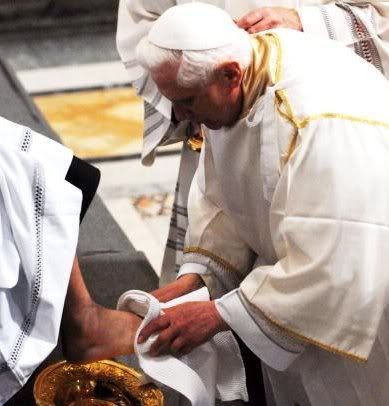
Friends, may we continue to follow in the footsteps of our Savior, bending over to wash one another's feet, sharing the bread and wine of Christ, doing our best to stay awake in the Garden of Gethsemane while offering prayers and support. Let us taste the body and blood of Jesus together today as we remember him and his profound ways of redemption.

Scripture:
John 13

Questions for Reflection:
Do we trust God enough to move into this depth of love, the depths of grace?
Do we trust God with all of our ourselves?
How is our desire to be in holy communion with our neighbors be most manifest?

Prayer:
By Thomas Merton,
I unite myself with those who gather in your name to receive the sacrament of your body and blood. You have made me one with you and one with them by the power of your Holy Spirit. Unworthy, I am called to your table and your hospitality. I shall gratefully sit and eat. Amen.

Peace to you,

3.31.2009

Week 5 Lenten Thoughts for PMC

Dear Church Friends,

In worship this past Sunday, the following confession was read in unison:

Jesus, we confess you as the Lord of our lives,
the author and perfecter of our faith, our Savior.
Grant us faith to submit to your lordship.
Give us strength to walk in your holy way. Amen.

When we consider these words in tandem with our Scriptural texts this week, perhaps you too, will be stunned by the ways in which God over and again does indeed strengthen us to walk in holy ways.

Scripture:
Jeremiah 31:31-34
Psalm 51
John 12:20-33

Even though the Israelites failed to keep their original covenant with God (you know, the 10 Commandments as they were given to Moses on Mt. Sinai), through Jeremiah God promised to write a new covenant for them--this time it would be on their hearts, lest they try to wander again. Jer. 31:33, "I will put my law within them, and I will write it on their hearts; and I will be their God, and they shall be my people..."

Then, Psalm 51 serves as a confession from King David after just having committed adultery with Bathsheba. Not wanting to follow the fate of his predecessor, Saul, David robustly and sincerely confesses his sin. He beseeches God in vs. 10, "Create in me a clean heart, O God, and put a new and right spirit within me."

Then, we get to Jesus in John's Gospel. The Christology is high (Jesus talks with God as Jesus is God), the moment is desperate (Jesus arguably realizes that his impending death cannot be avoided, vs. 27), and God speaks to the people from the heavens. And for what? Perhaps it is in part so Jesus can proclaim in vs. 32, "When I am lifted up from the earth, I will draw all people to myself."

Do you hear the refrain as it echoes through not just these passages, but through the entire God-narrative?
We sin.
We confess.
God redeems. God reminds us with the law written on our hearts, as it is manifest in Christ the Lord. God renews our spirit, and we are drawn into God's love through Jesus and by the power of the Holy Spirit. In this way, we walk a holy path.

Questions for Reflection:
What in our lives needs confessing? What needs to die?
How is Jesus offering new life? How is Jesus lifting us up and drawing us in so that we might walk forward in peace?

Prayer:
God of Grace,
Hear our pleas of regret, just as you heard David so many centuries ago. Bring to our attention our own need for mercy and redemption. We confess that we are a people who claim citizenship in your kingdom, and yet, we quickly reject membership to others who are searching for a home, a safe place in which to proclaim allegiance. As we acknowledge our fellow travelers on the holy path of grace and forgiveness, let us offer one another forgiveness again and again and again, in the name of Christ our Lord, just as you forgive us. Teach us to be faithful practitioners of your message in how we daily live.

May your hand restore us, God.
May the Spirit speak in the depths of our hearts.
May the strength of Jesus fill us to follow God's teaching,

rejoice in God's salvation
proclaim God's forgiveness,
and glorify Christ the Lord. Amen.


Peace be with you,

Week 4 Lenten Thoughts for PMC

Dear PMC,

This week we read about the Israelites in trouble. Venomous snakes are biting God's people, and as they plead for their lives they seek the council of Moses, their trusted leader. God's plan for healing and giving new life to the people was fairly unconventional and (dare I say it) idolatrous. Moses built a giant bronze serpent, wrapped it around a pole and elevated it so that when the people gazed upon it, they were healed and lived. Ummm...yeah. I realize I may be a bit naive in this, but would it not have been easier for God to simply eradicate the snakes from the desert, rather than allowing the people to continually be subject to the poison and also to their own fear?

Then, we read about the amazing Nicodemus, worried and confused about this Messianic figure, Jesus, who is busy shaking things up in the temple. So, fearing for his own safety (I bet it might have felt like a rotten snake bite), Nicodemus approaches Jesus in the middle of the night searching for some council. (Not unlike the Israelites running to Moses with regret.) What does Jesus say? "And just as Moses lifted up the serpent in the wilderness, so must the Son of Man be lifted up, that whoever believes in him may have eternal life."

The past few days in Darfur, Africa have not been going well, to say the least, since President Beshir has mandated the evacuation of most international aid groups. More war refugees are flocking to the camps only to face ongoing life-and-death issues, like a lack of water and dramatically overcrowded shelters. This is a fairly macro problem in the world that God needs to heal. And so perhaps it's a bit unfair of me to even mention it; but still, it is a giant snake bite that ought to cause all of us pain. On a more personal level, each of us may be challenged to keep trusting in God this week of Lent because we have our own snake bites that either aren't healing or may even be sucking the very life out of us--the wound is just too deep and too painful, and we're tired of looking up at the bronze image (i.e. Jesus) hoping for the restoration we so badly desire, only to see fifty more snakes when we return to work the next day.

God, can't you just get rid of the snakes?

"Indeed, God did not send the Son into the world to condemn the world, but in order that the world might be saved through him." John 3:17

Again, what an unconventional way for God to stop the pain and restore us to new life. Evil is not eradicated (not yet anyway), our hurts are still real, the snakes still slither about--but so, too, our hope may shine forth. The incarnation is not about judgment or a cessation of immediate trauma (although perhaps it can be). Jesus coming to earth is about new life. Jesus teaches us a new way of living. Jesus grants us permission to hope for a new reality, and Jesus modeled that reality for us. The bronze serpent will be raised up on a cross in just a few weeks so that we might be restored to life in the kingdom of God.

Scripture:
Numbers 21:4-9
John 3:14-21

Questions for Reflection:
What snake bites our festering in our lives?
Do we trust God with our pain?
Do we believe that God can transform our pain, no matter how unconventional the method may be?


Prayer:
We confess to you, Lord, all our past unfaithfulness:
the pride, hypocrisy, and impatience of our lives.
Our self-indulgent appetites and ways, and our exploitation of other people,
Our anger at our own frustration and our envy of those more furtunate than ourselves,
Our intemperate love of worldly goods and comforts, and our dishonesty in daily life and work,
Our negligence in prayer and worship and our failure to commend the faith that is in us.

Accept our repentance, Lord, for the wrongs we have done:
for our blindness to human need and suffering and our indifference to injustice and cruelty,
For all false judgments,
For uncharitable thoughts toward our neighbors and
For our prejudice and contempt toward those who differ.
For our waste and pollution of your creation and our lack of concern for those who come after us,

Restore us, and let your anger depart from us.
Accomplish in us the work of your redemption.

By raising high your bronze serpent, Christ on the cross, encourage us to gaze upon him and taste and see and touch and know and experience healing--life anew, in the kingdom of God. May be we feel the rub of your healing salve on our tender bites. We confess all of this, expecting your mercy to soothe the sore spots.

Bring us with all your saints to the joy of his resurrection.
Amen.


May you sense God in new ways this week,
Lauren Mayfield
Pastoral Intern

~Part of the prayer is from Rob Bell.

Week 3 Lenten Thoughts for PMC

Dear Pasadena Mennonite Church (and her constituents),

Our Lenten theme of trusting God came to a head for us in worship yesterday when Drew creatively and humorously compared Jesus driving out the money changers in the temple to a day at the LA County Fair. It was a great parallel that ended with us demanding Jesus to overturn the tables of the carnival games; you know, the ones that are rigged to rob us of all our money yet tempt us to empty our wallets when we still haven't managed to toss the ring onto the corresponding pin. I find something oddly comforting when it comes to placing my trust in a God who displays such passionate fits of temper when God's children are victims of a scam--be it financial, social, relational, environmental, or whatever.

I think it's no coincidence either that the author of John's Gospel places this story of temple chaos in the second chapter, very early in his Jesus narrative. Scholars speculate that perhaps this is so, because throughout the book of John we see a Jesus who is very divine, very in touch with God the Father, and very confident of his identity in relation to this Godhead. In other words, throughout John's gospel, Jesus most surely is Christ the Lord, the Son of God. So, it is not a surprise when Jesus angrily demonstrates that God's glory is not present in the temple scams, but instead, God's presence is powerfully manifest in the person of Christ. John wants to make that clear from the get-go.

We twenty-first century followers must be careful with such readings, however, not to turn an anti-Semitic ear to Biblical texts like this one. John was a Jew and therefore able to participate in this "family fight," so to speak. It's sort of like how I'm the only person who was aloud to call my little brother a dork when we were young kids. The second my best friend joined in the taunting, she was no longer permitted to say such untruths! Therefore, we do not have such liberal freedom to criticize the Law or Temple practices. This is why I'm so glad our other text this week is Psalm 19, "The law of the Lord is perfect...the decrees are sure...the commandments clear...the ordinance are true..." Instead, this week of Lent, by way of learning from Jesus' vehemence toward injustice, let us turn our attention to other unjust practices that dramatically need to be overturned in the name of Christ the Lord. Not too much of a difficult exercise given the state of our current American economy, much less the global one as well.

Scripture:
Psalm 19
John 2:13-22

Question for Reflection:
What or whom do we long for?
Who in our societies today are victims of a good scam?
Are we over-committed to the wisdom of financial gurus?
What must we sacrifice this week in order to have more time for the practice of justice?

Prayer:
Almighty God,
Help us keep our eyes on you.
Keep us clear from hidden faults and innocent of transgression.

Jesus is the visible manifestation of your holiness.
You are beauty,
goodness,
gentleness,
forgiveness, and
mercy.

Therefore, let our lives be of sound discipleship as we seek you by following the path of Jesus.
Prepare us to celebrate the mysteries of Easter,
as the feast of the world's redemption comes closer and closer.

In the meantime,
Let the words of our mouths
and the meditations of our hearts
be acceptable to you, O Lord,
our rock and
our redeemer.
Amen.

Working to stay the course with you,


P.S. I gave up fastfood for Lent. (ha.) Each time I have found myself craving an In-n-Out salted fry dipped in a swirly chocolate shake, I am glad to remember that Easter is on its way. Albeit, it's sort of an unconventional way to approach the expectation of Christ's resurrection, but the simple sacrifice gets my mind moving in a direction of thoughtfulness. How are your Lenten sacrifices going? Anyone else craving a good metaphorical cheeseburger yet? It won't be too much longer now...

3.09.2009

Week 2 Lenten Thoughts for PMC

Dear Friends,

Through God, with God, and because of God life comes from barrenness! And through the trial of acknowledging our empty wombs, i.e. our propensities to neglect God, naturally doubt might engulf us at times. Likewise, doubting the mysteries of faith might even accompany our longings to find God as well. But take heart, for just as Joe reminded us that all great s/heroes of the faith like Abraham, Hagar, and Sarah (even the others honored in Hebrews 11!) battled with seasons of intense questions and disbelief, we are not alone in our wandering and seeking. One of my favorite homiletical heroes is Fred Craddock. During Lent he says, "This walk to Jerusalem is becoming more like a climb. But the hills do give me better perspective."

Ahh, so much seems to hinge on our perspective, does it not? Our perspectives on life, on barrenness, on doubt, or on the trials that come from seeking God and living as if we are being redeemed. Does life only seem like a climb, not to Palm Sunday, but to the wilderness--the place we saw Jesus last week and Abraham this week? Take a minute to consider your own perspective on where God might be calling you to journey. Are you on the way up or stuck in a valley?

I encourage you to strap on tightly your hiking boots, grab a walking stick if need be, and venture further up those peaks of discipleship and faith. For just as Craddock climbs onward, may we join him and together understand how the perspective at the summit is full of grace and peace. The journey of Lent provides new routes on which we can accept and embrace God's presence. For God is with you, navigating this journey.

We know that Jesus recited part of Psalm 22 while he was on the cross. "My God, my God, why have you forsaken me?" Did you know that the Psalm ends triumphantly? Vs 26-27, "The poor shall eat and be satisfied; those who seek him shall praise the Lord. May your hearts live forever! All the ends of the earth shall remember and turn to the Lord..." How wonderful to think that perhaps Jesus may have recited the Psalm in its entirety. And if not, today we can recite all of it together. What a perspective from the top of the hill!

Scripture:
Genesis 17:1-7
Psalm 22

Questions for Reflection:
Do we dare to journey into the wilderness with God? Do we believe that God is with us in the unknowing wilderness or on the hills that we must climb to know God more?

Prayer:
Work your grace in us, O God, that we, too, may come to see that the hills offer a more complete perspective.
Do not forsake us.
Though we may feel like worms and not human, mocked or exhausted,
Deliver us.
Do not be far from us.
Even though we walk a barren path, you give us life.
Therefore our congregation comes to you with praise.
To, you, O God, be glory and honor forever.
Amen.

Peace from a fellow wanderer on the Lenten path,

Week 1 Lenten Thoughts for PMC

Dear Church Friends,
This past week and yesterday in worship, together we ushered in a new season in our church calender, Lent. Lent is a time of longing, anticipation, and expectation as we reflect on what we have done, or left undone, in the past year. Additionally, it is a time to put aside something of significance, to make room for the joyful hope that we expect will come on Easter through the resurrection.

So, just as the children in primary worship yesterday buried the word, "hallelujah," I invite you to metaphorically join in the burial ceremony. As we surrender this word, this proclamation and celebration, let us make way in the silence that follows in our hearts and in our worship for contemplation. Ash Wednesday reminded us that we are all dust and to dust we will return. This can seem a harsh reality. Yet, last Wednesday, the ashes were not marked on us in a smeary abstract image, but in the shape of a cross. It is a symbol that reminds us that even though we will all one day die, in the meantime we are to live in Christ, whose death transforms our own demise! Therefore, we need not fear the burial of "hallelujah," but instead we can embrace it with eagerness as we wait in faithfulness for the opportunity to shout it again.

Accordingly, during worship yesterday we learned that our true salvation, as a world, as a nation, as a people and especially as a church, comes not by way of our newly elected President or by any other worldly, empire means, but through the power of Jesus. Amen?! Yet, what a challenge this lays before us. The challenge to live with faith and trust in a Messiah who leads us into the wilderness. Yet, when we realize that God has already provided for our journey, we are then able to take the initiative to recognize God's action and follow Christ more fully. Jesus is on the move! --in a myriad of ways. Let us together, as a church, this Lenten season learn to better trust these movements so that we can join in and experience the joy of life in the kingdom of God.

Scripture:
Psalm 25
Mark 1:9-15

Questions for Reflection:
What tempts us? When are we in the wilderness?
How do we want to control our own destiny?

Prayer:
Faithful God, trusting in you,
we begin
the forty days of conversion and penance.
Give us strength for Christian discipline,
that we may renounce evil
and be decisive in doing good.

May integrity and uprightness preserve us,
for we wait for you.

We ask this through Jesus Christ, Amen.


Blessings to you this week,


P.S. Henri Nouwen offers a great resource, "Show Me the Way: Readings for Each Day of Lent." I borrowed part of the prayer from him. The latter part is from Psalm 25.

3.05.2009

I read these two thoughts everyday right now and will continue to do so until I feel like the ambiguity of our transition quiets itself.

My Lord God I have no idea where I am going.
I do not see the road ahead of me.
I cannot know for certain where it will end.
Not do I really know myself, and the fact that I think I am following your will
does not mean that I am actually doing so.

But I believe that my desire to please you does in fact please you.
And I hope that I have that desire in all that I am doing.
I hope that I will never do anything apart from that desire.
And I know that if I do this you will lead me on the right road though I may know nothing about it.

Therefore will I trust you always,
thought I may seem to be lost and in the shadow of death.
I will not fear, for you are ever with me, and you will never leave me to face my perils alone.

~Thomas Merton

Admittedly, it's a bit dramatic and not quite relevant since we are transitioning (hopefully) to something new and wonderful and adventurous, hopefully not a perilous experience. But there is nothing like turning to the saints who go before you for a little spiritual aide, eh?

We want life to have meaning, we want fulfillment, healing and even ecstasy,
but the human paradox is that we find these things by starting where we are
not where we wish we were...

And because we are human, it is in the realm of the daily and the mundane that we must find our way to God.

In our life of faith, then, as well as in our most intimate relationships with other people,
our task is to transform the high romance of conversion,
the fervor of religious call, into daily commitment.

~Kathleen Norris, sent to me by a dear friend early last week.

Lovely!

3.03.2009

tuesday after the first week in Lent

Henri Nouwen's prayer for today:

Why, O Lord, is it so hard for me
to keep my heart directed toward you?
Why does my mind wander off in so many directions,
and why does my heart desire 
the things that lead me astray?

Let me sense your presence in the midst of my turmoil.
Take my tired body,
my confused mind,
and my restless soul into your arms
and give me rest, simple quiet rest.

I find this meditation incredibly timely for many reasons. The ambiguity of hunting and hoping for a job feels relentless today. Dare we hope for a new posting on the SBL website, only to fall victim to the bad economy or lack of experience one more time? Tyler is better at handling this than I am. School seems to be bearing down on me right now since it's the end of the quarter; I am behind in my readings, turning in a paper late today, while scrambling to get another one written by Thursday, while hosting looming mental sites of the hebrew final and closing philosophy paper for the next week. ack. 

And well, more germane to the prayer, it's Lent. I am working to be disciplined in my discipleship these 40 days. I can do anything for forty days, right? I mean, that's how I get through each quarter at school, by solemnly chanting, "You can do anything for ten weeks...what's ten weeks in the course of eternity...merely a blip on the map of time..." At least that's part of my internal mantra which helps me to remain calm and collected.  So back to my discipline, lest this wandering blog entry shows too much of my wandering mind during prayer.

I gave up fastfood for Lent. I know, I know, how cliche to surrender sweets, alcohol, or other caloric past-times that are not good for us in the first place. But I don't think you understand (I am admitting this honestly and sheepishly-ha), I love cheeseburgers. My family does not hesitate in joking about my "meat tooth." I love salty, crisp french fries on the paper wrapper beside my cheeseburger, and mostly, I love dipping all of it in a bright, swirly mound of sugary, processed ketchup. yum! (I could totally go for a #2 with a diet coke like no other right now.) But I need to turn aside from the tempting drive-through windows and navigate my car, (er, I mean, my heart and mind) to more wholesome food. So, I am naturally turning to Henri Nouwen for steering help. 

Today he told me to be still and listen, so that my prayer life isn't nearly as monolithic or one-sided as usual. hmmmm...interesting, he's assuming I have an active prayer life. (Step 1: start praying again.) Thus, step 2: start praying through stillness and prayer. 

huh, not really all that divine or euphoric...or is it? I'm going to try it. Just for ten minutes a day in the beginning (about the time it takes if there is a long line at In-N-Out). And I will report back to let you know if what he predicts actually comes true--I find myself more and more 'hungry' for the voice of God amidst the craziness of life right now. Here's hoping, oh crap, I mean praying!


2.24.2009

Wading

So many people I know right now, most of whom I'm related to, are wading through murky waters of disillusionment with institutionalized church. And while I welcome this dialogue, even thrive on the potential that such disenchantment raises, I can't help but internally get a little panic-y and rant, "No! No! Don't be done with it! Don't give up." But then those who are ecclesially frustrated begin to relay a plethora of anecdotes that have taken place in the confines of the local church over years of service and ministry. Eventually the ignorance, frustration, and poor theology that is espoused in the stories only leaves me feeling a bit nauseated and fat, i.o.w., heavy hearted and sad right along with them. Dang! Why is that?! 

On a different, yet still related note, I listened to this fantastic podcast yesterday with my ole NPR buddy Krista interviewing a mother-turned-rabbi who was advising parents about the ways of inculcating spirituality in the life of their children. We are born with an innate awareness of a spirituality or mysticism that extends beyond ourselves and is part of the greater cosmos, the rabbi reports, that eventually prompts all/most young children to begin asking questions of their origin, along with reasons for pain and injustice in the world, tempered with more specific queries like 'who is God' and 'why should I believe in God.' (Not that any of that information is really all that new, just that I loved her response.) The rabbi says the point is not so much about answering our children's questions correctly, so much as it is about cultivating a vocabulary that promotes future dialogue about things spiritual and mystical. In a similar vain, I tend to agree with her when she espouses ways in which spirituality and a spiritual language is best developed and enhanced--not so much through our words or doctrine, but through our acts. (duh!) 

Even today in my philosophy class, we were discussing speech-act theory and how postmodern philosophers finally (almost) agree that language is performative. We don't know what a word means unless we understand the act that accompanies it. So, when I want to teach my children that injustice in the world is a problem, I hope that less then hearing me drone on ad infinitum about it, they will see me treating the homeless person with dignity, or we can together mourn over the loss of one of God's creatures when we see it on the side of the road, etc. 

And back to my initial point, is this one of the reasons so many of you are done with church in the modern sense of the word? Instead of having all of your doctrine well-articulated in a rational, uniform thought pattern (with words that have lost meanings), and instead of obeying the denominational "rules" about how one ought to conduct oneself in a given worship service or prayer meeting (with actions that are void of relevance), and instead of hounding members about their time availability and whether or not they are going to tithe 10%, why do our churches not embrace more radically the mystical elements of life with God? Why do we not less about indubitable faith propositions and more about intense questions of divine immanence and intervention, or how to live as community in American suburbia, and the list goes on? I, too, am tired of churches getting lost in the translation of what it means to be church. 

And as I debate denominational affiliation these days (more to come on that later), I find myself caught in the --dare I use the word 'trap'-- of going through the motions myself, of doing church the same old way. And for what, just to call myself "ordained," or is it because ordained pastoral ministry really is an authentic representation of church, i.e. family of God representing Christ to the world? hmmm. (Sorry if this sounds too cynical; I hope my message isn't hidden too far beneath it. I'm mostly just wondering.)

Immanent God, Intervening God: A Semantic Matter or Not?

I have been so hands-off of this topic for most of my seminary career; funny how it comes up in what is one of my last three classes before graduation this June--Anglo-American Postmodern Philosophy. (and yes! you read that correctly...I'm graduating in a few months!!) How does God speak? Does God speak? Is God a being who intervenes and if so, for what purposes? Or is our universe a modern, enlightened, rational, well-oiled machine that has been set in motion by a great Creator in the beginning and only left to its own workings and happenings so many billions of years later, i.e. today? 

I sort of imagine that last concept like one of those old fashioned toy tops where a kid yanks a string with force to send the top whirling across the table on its own volition and where it stops, nobody knows...not even God. The past few months, or years maybe, I have been moving progressively left in most of my theological suppositions. The ways in which I relate to God are more and more "liberal" as I wean myself off of tidy evangelism for a more hodgepodge of practical understandings of discipleship. But the movement of God in the world is one bit that I want to keep dusting off over and over so as to keep it pristine and easy.  

Thanks to liberals like Schleiermacher, I'm all about God being present in the Eucharist insofar as it is a gathering of God's children, as we all are created in God's image and  bearers of the Holy Spirit. I'm fine stopping there on this trajectory. A few stops too early on the theological tracks for my conservative brothers and sisters. What is more, I tend to veer away from the idea that God's miracles come to us in trite manifestations for our own edification. (I'm going to leave that vague for now as well.) Okay, so maybe it isn't as squeaky clean as I thought. In this way, God's presence traces back to the community for me. 

On the other hand (grab your dust cloth now), I cannot forsake the idea of a God who intervenes in our lives for the benefits of others who have yet to experience life in the kingdom of God. Isn't that what the incarnation was all about--God coming down so that we might have love | joy | peace? (There is a great Mennonite chorus we sing about this.)  I want to think that we are not on a conveyor belt like at the Toyota plant where everything is set in motion and cars are built whether or not the president of the company is present. God is not our CEO, and I am not an employee in the modern company pushing my way forward to grab a seat at the conference table in order to get a word in edgewise with the director. I regret that our modern liberalism has, in effect, worked us out of our own need for a present, immanent, redeeming God who still participates in the manifestations of what it means to be human and alive. Nor do I see God, however, as this little angel on my right shoulder arranging life so that my every want will be supplied. How consumerist is that?


So I had to write a brief reflection paper the other day on how this affects my prayer life. Do I pray for cures from disease? Cessation to genocide? Quick fixes and instant satisfaction? Isn't this a rebuttal against the ideas of free will and systemic evil? If God is going to immediately interrupt the transmission of AIDS, how does this not limit our response to God? (And won't skeptics like the Brites and other atheists ascribe it to modern science anyway?) Instead, would it not be more theologically astute/correct to ask for God to give grace and presence and peace to those suffering with AIDS while also asking for people who have resources to educate others about the prevention of AIDS to respond to a "call" to the need for this education? Like joining the Peace Corps?! Instead of praying for California voters to wake up and make gay rights legal over night, is it not more appropriate to ask God to interact in ways that awaken people to the need for more protests, education, and interaction with the issue so they can see up close and personal the bigotry that our current legal system promotes? I think the difference that I am trying to articulate is this:

Rather than God intervening in our world from the high heavens above (whatever the hell that means), God immanently exists from within all of us and from within all situations. In this way, (go ahead and lambaste me all you scientists) God, through the power of the Holy Spirit, calls us, provokes us, and leads us to ministerially (is that a word) respond and be present in the world in a way that benefits the good of the whole--not just ourselves (a.k.a. poor, pitiful, me--perhaps a syndrome to which only rich westerners are subject). Anyway, this makes sense for me right now. God gets to be bigger, albeit a bit more elusive, yet at the same time, still mystically present in the mundane of life while directing the whole of the cosmos for the blessing of all humankind. It is allowing me to pray on a personal level again because I do not have to be overly consumed with seeking the results of my prayers as they only pertain to me or my family or my situation in life. I can pray for my kids to get over their colds now so that they can be a blessing to the world in the ways that God created them to be, and free from the ways in which their colds were hindering this. In this way, it's not just about them leaving snot all over the cuff of their shirt and me being grossed out by it and wanting the laundry pile to stop being so insurmountable. I think God is more concerned with things other than my laundry, but I want to believe that God is totally concerned with whether or not my children are fully engaging in the world around them. 

Is this ridiculous? Am I just hanging on to this idea of God in the world so I can sleep better at night? Am I working too hard to keep the belief dust-free? Or do I need to let go of it completely like all those other liberals out there whom I so respect? Can someone please pass the Pledge? I need to get this idea dusted off.