3.09.2012

Women Warriors, Feminine Fabulous

I read Sheryl WuDunn and Nicholas Kristof's book, Half the Sky when flying to South Africa a few years ago, right after the book hit the shelves in '09 actually. Traveling to Cape Town with family and a few others to engage in some humanitarian efforts proved amazing minus the African-based, Tennessee-sponsored organization we traveled through, which was ridiculously conservative on all fronts. (Just to be an ass I donned my Barak Obama t-shirt more than once while there, and it had the desired effect.) Before I share how the book came to life for me, I want to say that I despise poverty porn--you know, the images and videos we see on melodramatic commercials that make us feel guilty for the money haphazardly spent on the six pack of beer in our fridge. Half the Sky transcends this category by introducing us to women in intimate ways of discovery and vulnerability.

The township we gathered in, Overcome Heights, portrays a huge irony even in its name. The refugees dwelling in the corrugated tin shacks on the southern peninsula sand dunes of Cape Town were not empowered to overcome anything in their lives. I found the half-rotten wooden sign holding the name offensive. We were inviting the inhabitants to TB testing, along with other general medical tests like blood pressure checks. A group of women who lived in the township met us each morning to walk us through the narrow outdoor corridors and into the bowels of poverty and destitution to invite their neighbors to the testing site.


It's also worth saying that I think slum tourism is despicable. If you google "Cape Town Township" an option to further your search automatically pops up as "Township Tourism." This multiplies rubber-knecking interstate car-wreck voyeurism to levels of obscenity. I get angry sometimes at the NYC tour buses driving through Harlem. Standing on the Amsterdam Ave. sidewalk waiting for my daughter's school bus to drop her off on the corner of a giant subsidized housing complex while tourists snap photos can easily leave me irate on our walk home. All this to say, I'm not posting any pictures of the people I met, except this one of a boy playing at the bus stop.


I saw a woman who had been burned by acid. She didn't want to meet us. But I felt like I already knew her thanks to WuDunn and Kristof.

Marsha, our guide and mother of two toddlers who also lived with her mother introduced us to a good friend. This girlfriend, err, nineteen-year-old woman, had three children under five living in one room with cardboard box flooring to keep the sand at bay. Of course she was prostituting herself to feed her growing family. Where did the kids go while she was working? She did not want us to stay long. We moved on after a quick greeting. A piece of my heart still sits on the cardboard in that room not knowing how to respond or speak. But again, I thank WuDunn and Kristof for giving me permission to meet her.

Most transformative for me, aside from the trail of unchaperoned kids under age 5 that walked with us throughout each day (because I passed out Smarties and stickers), happened unexpectedly for all of us, including Marsha.

A woman running a daycare about a mile deep into the township where the crime rates escalate through the tops of the dunes in the darkness of night, and the women succumb to terrors that police cannot reach.

The subtitle of the pulitzer prize winning book is "Turning Oppression into Opportunity for Women Worldwide."

The men of the township (on the whole) spend their days smoking at the corner, playing barefoot soccer in the nearby glass-infested field, or simply absent from the routines of fetching water from the central spicket, chasing the children to school, or working themselves. This woman called to us as we passed by unaware because the children saw my candy donations and were anxious to greet us. Turning at the sound, we stood stunned as we saw this woman's space. Filled with at least ten children, she had one stuffed Barney animal, a plastic walker with no batteries, and one pillow on the floor for reading time. (I'm not sure what she read to them.) She had a daily routine taped to the wall including snack-time, hand-washing, and nap. Otherwise, the children played in the sand, I guess. Once my Smartie supply was drained we inquired of her ongoing needs and promised to get her some of the monetary goods she requested. I had brought a shopping bag of infant shoes my own kids had grown out of. I felt stupid handing them to her. "Here," I thought, "I hope these help. I'm sorry I'm such a rich stupid fucker that I buy new shoes for my kids every few months."

She spoke to us of her own misery in watching these young toddlers walk the alleys alone while their mothers were forced to leave them for work, usually as housekeepers in the affluent white neighborhood across town. The mothers paid the woman about $1 per week to watch their children. The mothers were able then to provide food for dinner and snacks for the day with their income (notice I didn't say lunch). And the mother of the daycare could do the same for her own children.

Here is the other side of the city.

THIS is what I understand Half the Sky to embrace, promote, and hep us understand.

Last moment of sharing: While we were waiting in another crowded slum hallway embedded in the shiny tin, standing sticky and ashy in the hot sun, I asked Marsha what it feels like to meet with various groups of white people each month, show them her territory of life, receive their pity, to have them return about their business after a good self-pat-on-the-back at the end of the week. I asked if she was ever angered by it or frustrated by the injustice of white supremacy, corrupt governments building a state-of-the-art World Cup soccer stadium while forgetting its people in Cape Town, etc. She looked directly into my eyes for an extended moment before answering.

She thoughtfully responded, "When you are a mother trying to protect your kids from the horrors of night, and you are working to bring home a simple loaf of bread for the dinner table each night, you will take whatever help you can get. It doesn't matter what color their skin is or how long they stay."

Not much left to say after that.

I will never understand. And I won't ever be able to do enough to fix the atrocities of Overcome Heights.

I'm learning though, that I can be angry on Marsha's behalf, and on behalf of the woman running the daycare, and on behalf of the women cleaning the houses of South African wine-makers, and on behalf of those forced into prostitution and rape, and on behalf of all who are named in works like Half the Sky.

And I'm s...l...o...w...l...y... very, very slowly, coming to a point in my own spirituality that allows me to say that my anger does not need to manifest as guilt or pity. It can activate into something stronger, more productive, more sustaining and life giving.

March is Women's History Month. Yesterday, the 8th, was International Women's Day. There are lots of organizations, especially those focusing on women, like CARE who are celebrating this month with all sorts of education and awareness bits. But I wonder, do you know about Kiva? Kiva began a few years ago by a young American woman and her husband (I actually took classes with her brother in seminary), and the success of the non-profit has sky-rocketed since. It's micro-lending to specific women across the world of developing countries. You pick which women from the website you want to support as they begin their business ventures. Once your loan is repaid (you choose the amount) you can re-lend to another woman. This month, new users get a free $25 loan to start their involvement. So go start one, please. Thank you.

That''s the point of all this. Just to share my love of Kiva. Sorry it took me so long to get here.

One last thing, it is going to be the women who change the world and eradicate poverty. Each chapter in the WuDunn/Kristof book begins with an awesome quote. I like best the one commencing chapter 2, a sentence from Florence of Arabia: "Women might just have something to contribute to civilization other than their vaginas."

3.08.2012

Can Someone Please Help Me Understand This?


I mean, I'm all about women's liberation and love a good celebration of the capabilities of the female body. And I do love the iconic Demi Moore pose (way back in 1991). Although I do wonder what her son has to say about it now. But come on, Jessica Simpson, really? Claudia, Britney Spears, Christina Aguilera, and now Jessica Simpson? Really? For me this crosses from let's-acknowledge-the-beauty-of-a-woman right into how-can-I-skankify-something-as-fantastic-as-pregnancy...Oh, I know, let's put a giant yellow ring right on top of my nipple! I'm feeling a little embarrassed for her. Plus could they have touched up her arms and hips anymore? Please, I'm serious, help me understand! I'm open to a new perspective. On behalf of American hoochies, I apologize, Demi.

3.07.2012

Space | Place | Haste

First: Haste
Do you ever want to tell people to freakin' slow down?

Warning: this post is really random and covers about six topics.

I think this idea alone significantly spurs on my love for the elderly. Perhaps I've written on here before of my devotion to old-man-professors. (My husband will be one soon enough after all.) I completed my entire undergrad degree under the tutelage of an 80-year-old spiritual genius who swam in the school pool every morning at 5am. My favorite professors in seminary were the soft-spoken grandpas. My favorite congregants in the church are the cranky and authoritative, but supremely loving senior women. I preached a sermon once at PMC and the opening line was "Old people rock my world."--it was a very young congregation. With life comes experience comes wisdom comes a level of self-security that the rest of us only dream of. Maybe this is one reason, aside from the brittle bones, that you rarely need to tell a senior citizen to slow down. If we are not going to take the time to listen, then the loss is ours. I want NYC to get this holy concept.

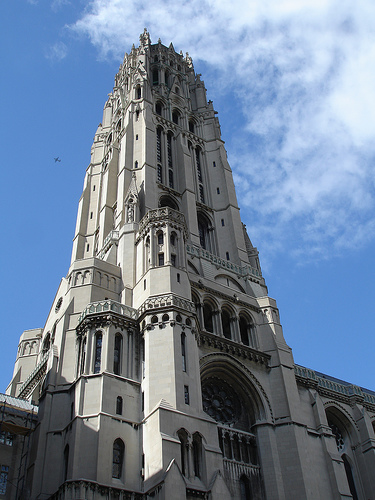
Enter The Riverside Church.

I won't take time speaking of its architectural splendor, Rockefeller's endowment, her majestic organ and carillon, nor do I plan to take up your time with stories of limestone carvings that can bring tears to your eyes, a golden Jesus suspended from the ceiling, and the pulpiteers who positioned it on the ecclesial map of churches to follow. It's all on the website anyway. The parts of this community that I most love and adore are the elderly members doing their best to keep it alive.

As I just begin to process the sixteen months of my employment in this community (I wrote that cover letter after all so many months ago), and as I view the stained glass of the Nave first thing from my bedroom windows every morning, I am struck time and again at the amount of space the building itself covers on Manhattan Island.

Second: Space
Remember there is no room on Manhattan, at least not unless you have a small (or gigantic) fortune to actually afford housing here. Most of Manhattan-ites live in nooks so small, in buildings so high it leaves the rest of the country stunned dizzy. Side note: We managed to find one small cranny of Central Park where if you situate your eyes at a specific perspective during the proper time of blossoming Spring with your body half-reclined into a contortion underneath a willow tree, there are not any skyscrapers in view. It's actually quite astounding for the fraction of a second that you can hold the twisted pose. Compare this to the view from the top of 30 Rock. (I refuse to pay the fee to elevate up to the peak of the Empire State Building.) The buildings that stand so majestic, threatening to pierce the sky, even a tree cannot block from view, from below they quickly shrink from the peak of one still taller. Yet, from the top of 30 Rock one can view in the northwesterly direction the spires of the Riverside tower as it borders the Hudson River. Something so triumphant and erect looks small and fragile. We lose this perspective in the haste of our daily living here in NYC. Everything around us becomes bigger than life--I wonder if because our time and space is so minimal.

One more bus to catch, subway doors to hold ajar, taxis to hail, groceries to manhandle for three more blocks, kids to bark across the avenue, complete strangers offering advice on how to parent, wind whipping your scarf in ways that blind you...the exhilaration and energy bustling in the streets literally never stops. I love it. But the rushing gets tiresome. The crowds overwhelming. The difficulty of running errands difficult to negotiate. So much so, that one easily loses perspective on the ways the rest of the world meanders about. It often makes me want to recreate the Ferris Bueller Sears Tower scene with forehead pressed against a glass panel a mile up in the sky to silence the busyness below into ant-like maneuvers of survival. That's what the top of 30 Rock does. You can only escape life-of-crazy by going up.

Until you meet the senior citizen residents of Manhattan.

Moving up the crowded sidewalks of Broadway with a walker immediately slows your world down to normalcy. Crossing a mega-avenue with a shuffling friend in icy weather creates more time to see all that I miss when chasing the kids on their scooters. Understanding the time that elapses between destination points when entering a crowded bus with a wheelchair only occurs to me when I'm inconvenienced by it as a fellow rider. Noticing the mundane of life sometimes feels next to impossible here. And yet, I claim that the simplicity of life is where I see God. No wonder I have missed this while living here, yes God and simplicity. My friends at Riverside have unknowingly done well to keep this alive for me on our lunch outings and through conversations about the trials of urban dwelling for those who are differently abled, but unable to leave the island.

Can one still find enough space and
can one slow down their haste enough to
create a sacred place in such a frenetic race

Third: Place
Wendell Berry is my brother's guru. (This and this are two blogs he started and maintains. That's him playing cricket with his King's College team in London on the second link.) Berry along with other great writers like Richard Rohr and Tich Nhat Hanh speak to the imperative of having a place--a home. In a reflection on the genius of Berry, after having spent an intimate Sunday afternoon with Wendell and his wife, Tonya, in the kitchen of their Kentucky farm home talking coal and other lofty agrarian topics, my brother writes the following,

We had been standing on the porch for several moments noticing the sheep on the southwest side of the house. We also noticed the vertical climb from the riverbank one must make to arrive on the porch...The aesthetics of the place reminded me of him, harangued, but in a good way. Everything here had a purpose and had been used and lived in. I aspire to live in my place as well as the Berry family appeared to live in theirs...When I put questions on the table I was consistently baffled by how smoothly he picked them up and dealt with them. We were sitting with a master of conversation. The work necessary for being as such had been done in the quiet of his own home and fields. It would be silly to try and name-drop and click through power point slides in his presence. Your only option is to be honest and thoughtful and, well, honest. As we sat in his kitchen for those several hours there was probably more silence than talking. It was ok to be quiet here. So often, there is nothing to say and yet we blandish each other with worthless chatter about how impressive we are. 


                                                        (Mr. Berry on his farm, Lanes Landing)


Might we all be so able and ready to create a place for people that welcomes silence, entertains new friends, and creatively speaks to the mystery of God at work. To think so deeply, live so consciously, and welcome so graciously proves daunting when we cannot slow down or find enough space to be ourselves, much less know ourselves. Unhurried living that celebrates community when it seems as if the space for such does not exist. As Berry taught this to Kyle, this is what the strident and savvy NY women at Riverside have helped me to learn and embrace. I'm convinced this is where God lives in Manhattan. Even if there is not enough space, God's place resides anyway. I'm glad to have met her here in this way of still, lingering lunch dates, intentional conversation, and ardent spirituality. What a surprise.
 

3.06.2012

Don't Wanna be an American Idiot

Soon after we left LA and arrived in NYC I sat in the balcony of the St. James Theatre trying to contain my weeping as I watched American Idiot.

The expression of anger and indignation resonated so powerfully within my core that while we were eating at Sardi's afterward (a hilariously dated and overpriced restaurant down the street) I could only identify with the depressed, couch-dwelling character of the show (stage right throughout).

(I couldn't find a video of the entire opening number, "American Idiot;" so if you have one send it my way.)

The jolting onset of intense media action,
                                           jarring electric sound, and
                                                     head-banging choreography awoke in me this intense rage
against the Man.
against war.
against chaos and disaster.

...arguably themes of the show and album.

And yet, like Rent will always reveal for me, the community that was broken and re-created from the shambles of atrocity and terror shows a depth originating from no kind of kindness--it's one that only stems from piecing together what's left after a bomb erupts and shatters the foundations of our lives.


This clip is annoying in the transitions but does well to throw you through the moods of the show.

They sing, "welcome to a new kind of tension...where everything is meant to be okay."

Is it...going to be okay?

I don't think so.

Hence the new tension of which they sing.

Living as it is okay or is going to be okay and denying the hurts and addictions of life. We who love this musical reject this notion and therefore resent this tension.

My last few entries of 2010 on this site hint at my emotional upheaval and confusion with everything I thought to be so certain. Taking too literally (and personally for that matter) foundations and ideas like Romans 8:28, "And we know that all things work together for good to those who love God and who are called according to God's purpose." Not that it's complete bullshit, but more like, let's keep things like this in context, right? And this idea too--keeping scripture and other writings in their proper genre and contextual paradigms--is a simple approach for mainliners but a theological breech for evangelicals. (I'm getting lost on a tangent.)


Getting back to the point: I value naming the tension, especially when it's a really profound one like seeking life in a world where everything is alright. First of all, how boring. Second of all, how dysfunctional!

Instead, let us break through to a new tension, one that's more honest and life-giving. I want to live not in the aforementioned tension of naiveté and ignorance of pain. Nor do I claim a tension of healthy lifestyles and extreme greed (as promoted by the American media, and highlighted in the musical) while ignoring the needs of the world's poor. Instead I claim a tension that flows from concepts like loving in the midst of hate. Not an eye for an eye, but loving the enemy.

So as I reflect back on my posts of 2010, on articles that have infiltrated The New York Times in the last forty-eight months, along with the overarching condition of humanity (here's where I get all existential) I wonder what empowers us to embrace the tension of living fully and with hope, particularly in the reality that things are not okay, and maybe won't ever be in this lifetime.

Chatting with some friends during dinner last weekend, in regards to their ongoing work with the urban poor population and efforts to eradicate the situation entirely I asked what keeps hope in their future alive. I want to know where they go for restoration. Similarly, a dear friend who works at Bread for the World, an anti-hunger organization, expressed a relief from the rigors of fighting an uphill battle through religion. An elderly African American lady who worked as narcotics rehab officer during the 1970's in NYC spoke to me of her faith providing sustenance. Something to still believe in at the end of the day. I agree, and yet, I still wonder--

How do we hope (through the power of Jesus, or our higher power, or the prospect of Enlightenment, or whatever fills this blank in your sentence)...how do we hope for things to be made well while maintaining integrity and awareness to the realities of life?

Did Neitzche simply name what the rest of us fear, "Religion is an opiate for the masses"? Do we hope in the intervention of a Higher Power so we can get some rest at night, in tandem with the prescribed Ambien? Or does God really reach out in saving acts of grace? If God exists to love and be loved as love, a love so bold and refreshing that all fear is truly cast out, where do I find this? What does this mean? I want proof.

My previous answers to this are what crashed when I wasn't looking.

And full circle back to the music of Green Day, it's worth getting angry about the ways American youth are jolted around in a schizophrenic quest for peace. Our institutions of family and church (to keep the list short) fail us. Yet, I wonder if when redefined and re-imagined in our current cultural mix-up, might these be a few places to hope freely in and work for a radical world where things will be just that...okay. Talk about a new kind of tension.

I don't want to be an American idiot. But I wouldn't mind being an idiot for something that authentically lives the realities of hope and love amidst trauma and loss. Let's just be honest about it. It's unpredictable.

Will Someone Please Look?

I have no posts during 2011. Not only was blogging absent from daily ventures, so was staying in touch with friends (not that you friends need reminding of my negligence). I also took a sabbatical from several of my other nerdy hobbies, as well as remained obsessive about things like running and Diet Coke. People, I was a working girl. In addition to working, I was recovering from new wounds of disillusionment, depression, and disbelief. Life the past eighteen+ months has concentrated on (re)integrating lauren--a process also known as individuation. It's a trail that most embark upon in their late adolescence. So...I was about a decade behind. Despite my developmental delay, I return to this venue of self-expression having 1) grown-up a bit, 2) embraced many thrilling life experiences of transformation, and 3) discovered that much of what is already revealed here regarding things Church, divine, and my hopes therein still propel me into each new day.

As this is my first week not working (I did just resign from my job), I find my mind buzzing in excitement with the projects ahead of me. Currently, I have the opportunity to assist a dear friend and mentor in publishing a book of prayers she has written during last ten years in her work as a minister and pastoral therapist in NYC. (I don't get prayer, and I often wonder to whom we actually pray; so, this interaction is no coincidence.) Second, little mayfield no. 3 will be here the first week of July. I honestly do not understand how these pregnancies keep happening (well, I do, but you know what I mean). Third, we are moving to Louisville, KY the first week of August...really need for the baby to come on time.

Ordination and Call to Ministry
Prayer
Institutional Church/Mega Church
Mainline Protestants
Racial, economic, and sexual diversity in the Church
Parenting two toddlers in NYC
Touring NYC
Churching in NYC
Working in NYC
literally living where we work
Therapy and Psychiatry
Old Friends who persist when I fail
New Friends who inspire when I deflate
Hymnody and Worship
Customs vs. Traditions
Cathedral or Local--are they mutually exclusive?
Sheepishly trying my pen at a bit of poetry
Technology
and
Mental Illness
Broken Relationships, Failed Marriages
Mistresses
Redemption
Justification vs. Sanctification (oh, I'm so die-hard Anabaptist on this)
United Church of Christ: theology and polity
Office Decorating
An open door policy
and my favorite love...Pastoral Care.

Lots to talk about. I welcome you to the conversation, and I look forward to reconnecting with my other favorite cyber-writers and -readers; I hope to get a blog roll in the margin sooner than later. I've missed you.

8.27.2010

Transition

This could end up a dangerous posting since I've just sat down to my two hours of free time while the kids sleep, and I don't have any real agenda with my thoughts right now. And I don't feel like doing laundry or writing a cover letter. (Any shout-outs on those options?) Tyler and I engaged in a fairly heated dialogue this morning about transition, expectations, and family. Yeah, I know--he was about two hours late getting to his office, the kids were desperate for some attention, and I am still not dressed for the day. So what! I'm such a fan of putting the relationship first. And Livia had a fabulous time clomping around the house in my sequin heels during the parental distraction. Our neighbors below already resent us, I'm sure.

Anyway, here's what I finally and triumphantly laid down for him while simultaneously throwing my hands from the football touchdown cheer to the exasperated side dangle, "I suck at transition!" In more words or less. It's so hard and exhausting for us introverts. Does it have to be?

Tyler grooves on it almost (therein destructing my introversion theory), which perhaps only makes my inability to warmly embrace it fester. In a nutshell: I miss In-n-Out, and PMC. I miss my friends from California, Connecticut, Alabama, and Kentucky (even though they, too have all moved elsewhere). I miss the neighbors that I know, the routines that were in place, and more generally, the ease of familiarity. Not necessarily in that order. (wink.)

I hate to admit it, but I'm a relatively unmotivated person when pursuing my dreams because I find the initiation process daunting and myself too insignificant. (Go ahead, I'll pause for you to get some tissues.) Let's be honest, it's so much simpler to bash and rest in cynicism than it is to continually balance out on that damn limb, risking rejection (for various reasons), or worse yet, failure, or even worse, the reality that we aren't really perfect (Insert stunned gasp here). So that when the assertions of trying new things for just one more day feel totally insurmountable, I resign myself to actually rest in the ambiguity of new places, relax about the fact that our latte factor is zilch so the sheer ubiquity of Starbucks has still gone untouched, and well, fuck taking the stroller down the subway stairwells by myself--kids you're learning to walk! Hear me roar! And yet, and still, once more, I simply and pathetically arise to one more inevitable new day and once again find it time to analyze and reassess what it is I'm actually trying to accomplish.

Right now, I have no clue. Which then finding myself in a circular, yet completely circuitous route, not unlike the book, "If you give a mouse a cookie," I can only conclude with the harsh reality, I suck at transition. (And unfortunately, this isn't anything a cold glass of milk and a crisp straw is going to cure.)

Oh when will I be discovered and my natural talent demanded by others?

Here ends the pity party.


Come Holy Spirit, Come.
Come winds of peace, Come.
Aright this course within me.

Creator of goodness and ultimate guru of complete health,
dharma,
karma,
and sanctuary, I am your Bodhisattva.
Teach me your stillness.

May your comfort call us to action
Your tenderness to wholeness
Your discipline to an end of suffering
Your compassion to a cessation of selfishness.

Then we can freely set-forth through dangerous waters
Seeking that which demands us to relinquish hesitation,
yet embrace frustration,
so that fresh elixirs brewed in your laboratory of love,
might be consumed by willing and thirsty souls who,
in their new strength,
will bring change.

Transition us from a place of woundedness and isolation
to safety and completion,
from a place of misunderstanding and vehemence
to grace and acceptance
from a place of sarcastically jovial, dysfunctional jokes
to inspired flames of justice and service.

We are your servants. May we never grow full of your mercy while you bless us to bless.

8.14.2010

54 Pi Rent Obscure

Four points of interest whirling in my brain right now preventing sleep, well, and the diet coke that was addictively consumed too late in the day.

I read a few weeks ago for the first time recently Life of Pi.
I am currently reading, and nearly finished with Jude the Obscure.
I watched (admittedly) with both of children four times last week Rent, the movie.
I watched this evening with Tyler, Mike Myers' 1998 film, 54.

They are all merging in ways that represent where I want to be, how I want to live, and the types of relationships I hope to maintain.

The last twelve months of my life have turned me upside down. So I pierced the inner cartilage of my ear and am seriously considering a highly visible tattoo on my right forearm. (Who says rebellion only happens when we're teenagers?) But more significantly, the disillusionment I am undergoing with all things God, no religious, and (ok fine) yes, God, leave me exhausted and well, depressed. Enter Life of Pi.

Holy Cow this book is amazing.
Fact vs. Narrative.
Modernity vs. Postmodernity.
Concrete data vs. Experiential reality.
etc...

Pi says this early on his own narrative:
"What of God?"..."An intellect confounded yet a trusting sense of presence and of ultimate purpose. I can well imagine an atheist's last words: 'White, White! L-L-Love! My God!"--and the deathbed leap of faith. Whereas the agnostic, if he stays true to his reasonable self, if he stays beholden to dry, yeastless factuality, might try to explain the warm light bathing him by saying, "Possibly a f-f-failing of oxygenation of the b-b-brain," and, to the very end, lack imagination and miss the better story."

Stunning. How does one articulate so fully with mere words such a colossal theodicy? This is a hermeneutic I've been struggling to find since I audited my first grad class at Yale Divinity. Which is the better perspective--dry yeastless factuality that always makes sense, sees death as only a cessation of oxygen? Or is it the story, albeit embellished, but the lens full of adventure, love, and mystery? Damn you modernity for convincing us that we have to have this God thing so well figured out. Thank you Yann Martel for reminding me that the story is what fulfills us. How, then, even when our rafts are lost at sea, our food rations growing sparse, hungry tigers lurk beneath us in the life boat, all amidst the threatening silence of God do we still reject dry, yeastless factuality as the only spectacle with which to see? I want, even in the mystical silence of hurt and trauma to claim the unintelligible, imaginative, sustaining, and intellectually confounding presence of a god. or of grace. or of peace. not of having answers or certitude. but of a comforting presence inspite of life's shipwrecking storms.

Rent. What a musical. What a show. (I was lucky enough to see one of its last Broadway performances a few years ago.) What a message to try and capture on film. While I don't love the story rearrangement in the film, it's hard not to adore anything that is going to promote Tay Diggs' gleaming whites while he is, (steal my heart away) singing no less! (Breathe, Lauren.) Every time I hear or watch or see this I can't help but walk away from it thinking, "This is it. Community. Pure and simple." --when in actuality community is messy, controversial, and a sum of broken parts trying to make a whole. Confused sexuality, homosexuality, heterosexuality awry with AIDS, "lezzies, dykes, cross-dressers too," so the lyrics go...
drugs, depression, unmet dreams, destroyed dreams, fear of dreaming for more, betrayal, fear, and yet, the tenderness of acceptance that only comes when we allow ourselves to be so brutally vulnerable and honest. It's the community in which I want to live.

Liv asked me if Maureen and Joanne are married because they love each other like I love daddy. I responded yes, of course. And she did not think another thing of it. Nevermind that it's two women. She also is convinced that Angel is an actual female. Sometimes we have to watch twice her first appearance in the film as "she" Angel. It mesmerizes both my kids, the entire film does. And well, perhaps for me the show culminates prematurely with their gathering on the F train to sing about escaping the hardships of urban dwelling with the dream of opening up a restaurant in Santa Fe. So much more to say on this, but I'll leave it at that. I want to live such a fantastically honest, real, uncompromising, and supportive existence in equally close proximity to my own friends.

Studio 54 offered to me the competing end of the spectrum. Here the drugs, sex, rock and roll (does disco count?), dancing, and money arrested community. Brokenness lead to no community or wholeness in this film. A place built to host the never ending party, Studio 54 entertained every Hollywood A-lister in New York City. Andy Warhol (whom you know I adore), Truman Capote, models galore, even California's govenator, 'course he wasn't governor then. How ironic then that those at the party are so isolated from one another. How willing we are to buy into the illusion that we can cover our hurts and despair by cranking the music a little louder, staying out a little later, and topping off our glass of champagne just one more time. (At least, this is part of what I keep coming back to in my reflections on Steve, the owner's life. He died at 45, went to jail for tax evasion, and was a closeted homosexual. All so tragic.) His own party was an effort to ignore the narrative that was being written around him. Or was it an attempt to rewrite one with more pizazz? I don't know.

I go back to Pi's wonderings here. At what point do we give way to our realities and chuckle with maybe a healthy dose of cynicism and say, well, death is what happens when you smoke, drink, and drug too much. Isn't that the dry, yeastless factuality? What makes the story so interesting (to me right now) is the possibilities of something better...a place in Santa Fe. A place where the opportunity to party is still present and even enjoyed, but it's something new that can be experienced with people you love. Even when your girlfriend commits suicide and informs you that you have AIDS in a note, you can still creatively join together in a fusion of something more. God, still, is silent, but the story writes on.

And finally Jude, the Obscure. The title makes it for me. He wants to be special, arrive in his beloved city of Christminster to dwell and stimulate his mind with fellow learned men. But the obscurity of his story off-sets the reader from ever fully falling in love with this character. Just as his old professor mistakenly bought a piano and was forced to drudge the thing around with him, even though he can't even really play the dumb thing, Jude married the wrong fling and his dreams of education and later clericalism suffer and ultimately die. He deems himself too unprivileged to stay in Christminster after one too many rejection letters from his favored institutions, and he flees his studies of the divine when the temptation to love his married cousin grow too fevered and lustrous. His nomadic quests for meaning and fulfillment only leave him evermore resentful of his absent wife and personal disillusionment. For Jude, God's silence serves as a trap, from which he cannot escape. His obscurity and normalcy trap him into an entirely different cynicism. One that he vowed never to cover up again with strong drink or other "blasphemous ways."

All this to say...
I need a drink and a smoke! (haha, I crack myself up.) I think I'm going to go to church tomorrow at Broadway UCC. (We'll see, I haven't made it there yet.) But I need people right now to gather 'round me and by the sheer power of example shove me back into the narrative. Living out of cynicism leaves me angry, discontent, and honestly, wanting another glass of wine when I've finished the first few. What about a narrative that is not about getting it right or missing the mark? It's not a narrative about whether or not what the Bible says really happened.It's not about what works for me should work for you. Instead, it's a story about inspiration, love, and life. It's definitely the pieces that keep things interesting, keep us from getting lost in our own despair, and like Pi and the cast of Rent, remind us of what life is really all about-- It's a narrative where marriages are broken, cancer cells continue to grow, and lay-offs persist. Yet, these facts aren't all there is to it. There is a tiger in the boat. An island covered in deadly algae, and a Mexican infirmary just when Pi needs it the most. A narrative that saves Mimi that night Roger finds her in the park, and enables the rest of the cast to celebrate Angel's vision of peace while they mourn his loss.

Final thought. It's not lost on me that all of these works are incredibly dated by today's cultural milieu. Rent came out in the mid '90's. Studio 54 was an entire generation before me. Thomas Hardy wrote Jude the Obscure a gazillion years ago, and Yann Martel is a product of the '60's. These stories are dated, yet timeless. I love the puzzle of finding my own piece in their retellings.

I also need to start meditation on a regular basis. I f I can, I'd love to do this in a buddhist community. We'll see where and how that chapter follows church tomorrow. Peace. I want to stand on this stage and measure my life by the love I give and receive. That's one helluva story.