4.28.2009

A Buzz Word about God

Since I am graduating in seven weeks, yes, seven weeks (!!) I have been entertaining off-and-on a resurgence of life questions. What is my denomination? Do I believe in denominations? Why am I not already on a path to ordination? Should I not have an ordination service following the week of the commencement festivities? Where will I pastor? In what context? Shouldn’t God have already worked all this out?! I am twenty-eight, after all!?

Birthing two kids in the middle of my degree has offered me a bit of permission from God (myself, really) to let up on the how’s, why’s, and when’s in place of some more favorable peace. Surprisingly, as life grew busier, the peace became more present. When all of the above questions were hovering around like a poisonous bee at the start of my seminary tenure I thought I was going deaf from the numbing ZZZZZZzzzzzzzzz of where is this education leading? The loud buzzing never really went away, but as life progressed, it did drop down to a low dull so that I could proceed through life. Now that damn bee is back and the buzzing can be heard at decibels so electrifying I wonder when our nosy neighbor is going to call the cops for noises in our apartment louder than city ordinances permit. (Maybe I just have mental illness.)

Anyway, I have initiated several conversations with various people in the ministry and my family with the hopes that their guidance will numb the sound. They are people whom I trust and consider wise on such subjects like what the hell is God doing with my life. Their opinions have slightly varied and their ideas of what would be best for me are even sundry, yet one element of the dialogue has remained consistent amidst all my questions and anxiety (again, mostly self-imposed).

God loves you.

Hurumph. I usually huff a little and slightly audible sigh, feeling perplexed wanting more clarity about the here-and-now and not really wanting to continue such an esoteric line of thought. Then I think, actually God’s love is extremely tangible. That’s when my shoulders relax a smidgen. My breath comes a bit deeper on the next inhale, and I reluctantly remember this profound reality. Yes, God loves God’s people.

God did not bring me this far in life, with a husband, two kids, an (almost) advanced degree, various life experiences across the country, etc. to suddenly say, “ummm…yeah, good job on the grades at seminary, Lauren. You’ve arrived. You are now a Master of the Divine. So….yeah, good luck with all that. See you in a few years at the next resurrection.”

Sometimes I tend to think that’s the case, given what I’ve learned and misunderstood about process theology and practical theology and everything in-between that discusses how God may or may not interact in the world. However, everything inside me screeches (or wants to stand) against that.
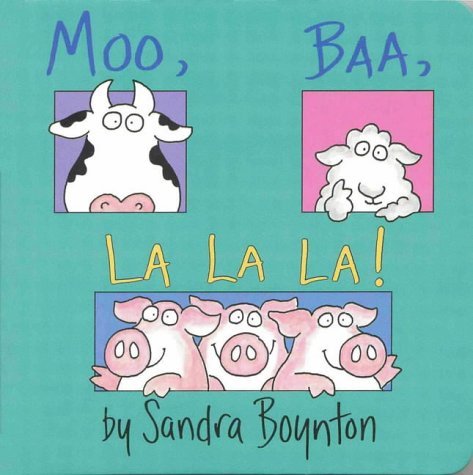
Liv loves the book “Moo, Baa, La La La” by Sandra Boynton. (A great children’s poet!)
It goes:

A cow says, “Moo!”
A sheep says, “Baa!”
Three Singing pigs say, “La! La! La!”
“No, no,” you say. “That isn’t right.”
The pig says, “Oink!” all day and night.

Rhinoceroses snort and snuff
Three little dogs go, “ruff, ruff, ruff.”
“Quack,” says the duck and a horse says, “neigh.”
It’s quiet now.
What do you say?

No! No! I say to God, “This isn’t right!” you love us still, to our delight.
(Sorry, I suck are rhyming.) Which is code for, God’s not going to forget about us (i.e. me). Or anyone for that matter, even if you are marginalized and deprived of certain human rights. (Do I even have the right to say that? That’s a whole ‘nother post for a later time. We’ll see if I still believe that after a trip to Cape Town later this year.) even if you are in the midst of foggy transition that rates low on the frontal visibility scale.

So yes, my life seems to be transitioning, the bee is buzzing, and yet “it’s quiet now.” What do I say? The opportunities are many and the possibilities somewhat limitless. What a tremendous, inexplicable, unmitigated gift! Truly. Who am I to query about it being otherwise simply because it’s a bit vague and full of ubiquitous ambiguity right now?

It’s quiet now. What do I say?

Well, I’m a bit too overwhelmed really to say much at all. I speculate that my husband is as well since he’s on a parallel existential track of life-purpose. Good timing we’ve got, eh? At least one of us in the marriage could be a stabilizing force. Oh well. ☺

Instead, I think I will permit the golden Barbara Brown Taylor to once again, use her magical powers of clear and metaphorically enhanced articulation to speak for me.

In response to Terry Gross’ inquisition about her underlying assumptions of the word/image of “God,” as she perceives and believes it to exist, Taylor inspires me with this.

“When I say the word, “God,” I am so aware that I’m using a code word…I suppose my own image, my own idea of God as imperfect and evolving as it is, right now, would be the glue that hooks everything together. The consciousness that moves between all living things…I do not envision a large person…I envision instead some (a slight pause) presence so beyond my being. A presence that both knows the stars by name and knows me by name as well. That is not here to be useful to me, that is not here to give me things as much as to ask me to give myself away for love …but when I say I believe in God, I trust. I trust in the goodness of life, of being. I trust that beyond all reason. I trust that with my life.”

To give myself away for that love…That love which is God’s-self. So then I think, duh. I can do that. What’s so hard about that? And then I’m awake all night wondering about that. Geesh (wink, wink).


(I wrote this on my flight to DC. Expect a follow-up soon, post-trip.)

4.09.2009

Maundy Thursday

Well Friends,
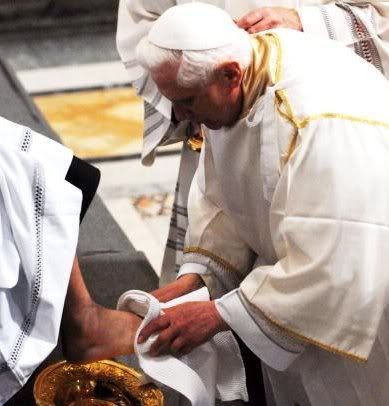
It's Maundy Thursday today. The time in our church calendar when we are to receive Jesus' new commandment, (which is what "maundy" means in Latin): "I give you a new commandment, that you love one another. Just as I have loved you, you also should love one another. By this everyone will know that you are my disciples, if you have love for one another." ~John 13:34-35.

Maundy Thursday is the practice and acknowledgment of several different elements in the Holy Week Discourse of Scripture. First we see Jesus wash the feet of his disciples. Then they celebrate the Last Supper, after which Jesus, "with a troubled spirit" (John 13:21) identifies Judas as the betrayer, and then the new commandment is offered. Finally, the day comes to a sleepy close in the Garden of Gethsemane.

There is so much dense theology in this day, that a short devotion here cannot even begin to encapsulate all of it. You may want to pause here to read all of John 13. In the short phrase in vs. 2b-3 it's as if we see Jesus finally understand how his ministry/mission will end. "And during supper Jesus, knowing that the Father had given all things into his hands, and that he had come from God and was going to God..." I wonder if there was any relief that he didn't have to continue wondering where this was all going, this ushering in life in the new kingdom stuff? Or was he to plagued with worry or suspicion to have any room for positive emotion. At this point, John tells us that Jesus understands how his time on earth will end--in death. How difficult it is when we long for our dearest life partners to understand what ails us. What loneliness Christ must have endured this day.

My final thought is this. Here is Jesus, the penultimate example of God's love for the world getting ready to die, but he must first identify the one among them who will give Jesus up to the Romans. And because that love is so authentic, thick, and natural, the disciples have no idea who it is. Vs. 22, "The disciples looked at one another, uncertain of whom he was speaking. One of the disciples--the one whom Jesus loved--was reclining next to him...he asked him, "Lord, who is it?" At which point Jesus dipped the piece of bread into the dish and handed it to Judas. Had it been one of us preparing for death, communing one last time with our closest confidants, knowing that one of them was a traitor only for a few silver coins, how could we not help but to treat him differently, or a bit coldly, to such an extant that at least one of our other more intuitive friends would have surely picked up on the tension? No one here notices, because there is nothing to notice. Jesus treated Judas no differently. Truly, he lived his message. This is just but one more example.

Friends, may we continue to follow in the footsteps of our Savior, bending over to wash one another's feet, sharing the bread and wine of Christ, doing our best to stay awake in the Garden of Gethsemane while offering prayers and support. Let us taste the body and blood of Jesus together today as we remember him and his profound ways of redemption.

Scripture:
John 13

Questions for Reflection:
Do we trust God enough to move into this depth of love, the depths of grace?
Do we trust God with all of our ourselves?
How is our desire to be in holy communion with our neighbors be most manifest?

Prayer:
By Thomas Merton,
I unite myself with those who gather in your name to receive the sacrament of your body and blood. You have made me one with you and one with them by the power of your Holy Spirit. Unworthy, I am called to your table and your hospitality. I shall gratefully sit and eat. Amen.

Peace to you,

4.07.2009

Our Place in History

A few weeks ago, Kyle, Tyler, and I attended panel #2 of a two-part series at Claremont School of Theology. The first one was on Church in Society, which I was sad to miss, and the second was on Transforming Society--or something like that; I don't remember exactly. The panel consisted of several liberal theologians from top schools across the country. In a fascinating attempt to keep the audience involved, we jotted down what we believed to be theological predicaments that ought to be at the forefront of theologians' and clergies' minds when it comes to making the world a better place. Then the scholars each volunteered to address a specific one. The list was the usual: economic meltdown, AIDS, poverty, homosexuality, global warming, and on and on. It was actually quite the downer. But to hear the smart people articulate approaches to discuss and even implement change in these areas was inspiring and encouraging. (It reminded me again and again that before I am anything else good, like a philanthropist, volunteer, educator, mother, etc. I am a spiritual being intimately related to my environment, family, neighbors, and Creator. --Perhaps affirming again that I am entering the right profession for me.)

Afterwards, while the three of us were enjoying a flavorful and aromatic hookah at a trendy Mediterranean joint in the Claremont Village, the conversation veered into something along the lines of, what right do those people, those smart people, the "scholars" and theologians have to make any claims about anything, be it a doctrinal truth they uphold, or personal approaches to social issues (like Just Peacemaking Theory), or whatever. Before we can argue one way or the other for anything, don't we need to humbly position ourselves, our minds, and our ideas about the world in a larger context, and that context being all of world history? I don't think the panel would have disagreed with us, but they certainly might argue that there isn't always time for such macro-approaches to conversation, so we need to just assume some things from the get-go. However, we decided that there needs to be time, if only a sentence or two, in which the speaker can acknowledge her seemingly inconsequential ideas and then go on to share them at length. This would make the ideas so much more credible, would it not?

But how un-Enlightenment of us to admit from the start that perhaps we do not have this...this God-thing, this theology-stuff all figured out, especially us scholars. I'm not harping on the academy, just the opposite, in fact. I love it when I begin a new class each quarter and my professor confesses not having all the answers, not always understanding everything that ought to be understood, and therefore not always able to articulate complex ideas about the nature of God in as clear way as necessary. I like these professors way more than the ones who boldly and arrogantly claim, "look kids, here's how it is. now go pastor."

So, all that to say, I opened Latourette's volume-one church history book last week (a mere 1000 page work) and to my delight, the entire first chapter devotes itself to adequately addressing the need for the church to remember the small, small, small fraction of time it has existed and experienced influence on the world when considering the course of world history. Fabulous! I was a bit embarrassed that I had a church history class on Evangelicalism at Yale in Latourette Hall, that this is my third church history class at Fuller, in which I read pieces of Latourette's works in the prior two, and it was only this fourth time that I bothered reading chapter one, and that's just because Dr. Bradley actually assigned it. (THANK YOU!)

Here a bit of what he says.

Christianity is relatively young. Compared with the course of mankind on the earth, it began only a few moments ago...If one accepts the perspective set forth in the NT that in Christ is the secret of God's plan for the entire creation...Christianity becomes relatively even more recent, for the few centuries since the coming of Christ are only an infinitesimal fraction of the time which has elapsed since the earth, not to speak of the vast universe, came into being...Christianity has been present during only a fifth or a sixth of the brief span of civilized mankind.

Again, fabulous! Now, I am can talk, or listen to someone else talk about her doctrine of the trinity. Now I can discuss the significance of Protestant denominations. Now, I can embrace the call to live as a pacifist. Now, when it's all contextualized and we are free to admit that we don't have this Christian-follow-Jesus-live-in-the-kingdom-life-thing all figured out can I begin to start claiming Christianity and following Jesus to that I can live life in the kingdom of God. So please, yes, let's have as many panels as possible that discuss minutia like hte doctrine of the Trinity, just so we can remember that although it's a huge and orthodox concept, really, it's fairly small. (How heretical of me, I know, since our entire faith hangs on the existence of said doctrine.)

I'll stop with this last quote which I find incredibly freeing. Latourette goes on to say,

If Christianity is only near the beginning of its course it may be that the forms which it has developed, whether institutional, intellectual, or ritual are by no means to be final or continuously characteristic.

Praise God! Let's move on people! And thank you to all you pastors, theologians, preachers, and laity out there who are already embodying this for me as I seek my own road of pastoral ministry. This all merges for me in a way that has given me more permission to dream about new church communities outside the institution, denominational constraints, and the pressures that come with ordination. hmmmm....

3.31.2009

Week 5 Lenten Thoughts for PMC

Dear Church Friends,

In worship this past Sunday, the following confession was read in unison:

Jesus, we confess you as the Lord of our lives,
the author and perfecter of our faith, our Savior.
Grant us faith to submit to your lordship.
Give us strength to walk in your holy way. Amen.

When we consider these words in tandem with our Scriptural texts this week, perhaps you too, will be stunned by the ways in which God over and again does indeed strengthen us to walk in holy ways.

Scripture:
Jeremiah 31:31-34
Psalm 51
John 12:20-33

Even though the Israelites failed to keep their original covenant with God (you know, the 10 Commandments as they were given to Moses on Mt. Sinai), through Jeremiah God promised to write a new covenant for them--this time it would be on their hearts, lest they try to wander again. Jer. 31:33, "I will put my law within them, and I will write it on their hearts; and I will be their God, and they shall be my people..."

Then, Psalm 51 serves as a confession from King David after just having committed adultery with Bathsheba. Not wanting to follow the fate of his predecessor, Saul, David robustly and sincerely confesses his sin. He beseeches God in vs. 10, "Create in me a clean heart, O God, and put a new and right spirit within me."

Then, we get to Jesus in John's Gospel. The Christology is high (Jesus talks with God as Jesus is God), the moment is desperate (Jesus arguably realizes that his impending death cannot be avoided, vs. 27), and God speaks to the people from the heavens. And for what? Perhaps it is in part so Jesus can proclaim in vs. 32, "When I am lifted up from the earth, I will draw all people to myself."

Do you hear the refrain as it echoes through not just these passages, but through the entire God-narrative?
We sin.
We confess.
God redeems. God reminds us with the law written on our hearts, as it is manifest in Christ the Lord. God renews our spirit, and we are drawn into God's love through Jesus and by the power of the Holy Spirit. In this way, we walk a holy path.

Questions for Reflection:
What in our lives needs confessing? What needs to die?
How is Jesus offering new life? How is Jesus lifting us up and drawing us in so that we might walk forward in peace?

Prayer:
God of Grace,
Hear our pleas of regret, just as you heard David so many centuries ago. Bring to our attention our own need for mercy and redemption. We confess that we are a people who claim citizenship in your kingdom, and yet, we quickly reject membership to others who are searching for a home, a safe place in which to proclaim allegiance. As we acknowledge our fellow travelers on the holy path of grace and forgiveness, let us offer one another forgiveness again and again and again, in the name of Christ our Lord, just as you forgive us. Teach us to be faithful practitioners of your message in how we daily live.

May your hand restore us, God.
May the Spirit speak in the depths of our hearts.
May the strength of Jesus fill us to follow God's teaching,

rejoice in God's salvation
proclaim God's forgiveness,
and glorify Christ the Lord. Amen.


Peace be with you,

Week 4 Lenten Thoughts for PMC

Dear PMC,

This week we read about the Israelites in trouble. Venomous snakes are biting God's people, and as they plead for their lives they seek the council of Moses, their trusted leader. God's plan for healing and giving new life to the people was fairly unconventional and (dare I say it) idolatrous. Moses built a giant bronze serpent, wrapped it around a pole and elevated it so that when the people gazed upon it, they were healed and lived. Ummm...yeah. I realize I may be a bit naive in this, but would it not have been easier for God to simply eradicate the snakes from the desert, rather than allowing the people to continually be subject to the poison and also to their own fear?

Then, we read about the amazing Nicodemus, worried and confused about this Messianic figure, Jesus, who is busy shaking things up in the temple. So, fearing for his own safety (I bet it might have felt like a rotten snake bite), Nicodemus approaches Jesus in the middle of the night searching for some council. (Not unlike the Israelites running to Moses with regret.) What does Jesus say? "And just as Moses lifted up the serpent in the wilderness, so must the Son of Man be lifted up, that whoever believes in him may have eternal life."

The past few days in Darfur, Africa have not been going well, to say the least, since President Beshir has mandated the evacuation of most international aid groups. More war refugees are flocking to the camps only to face ongoing life-and-death issues, like a lack of water and dramatically overcrowded shelters. This is a fairly macro problem in the world that God needs to heal. And so perhaps it's a bit unfair of me to even mention it; but still, it is a giant snake bite that ought to cause all of us pain. On a more personal level, each of us may be challenged to keep trusting in God this week of Lent because we have our own snake bites that either aren't healing or may even be sucking the very life out of us--the wound is just too deep and too painful, and we're tired of looking up at the bronze image (i.e. Jesus) hoping for the restoration we so badly desire, only to see fifty more snakes when we return to work the next day.

God, can't you just get rid of the snakes?

"Indeed, God did not send the Son into the world to condemn the world, but in order that the world might be saved through him." John 3:17

Again, what an unconventional way for God to stop the pain and restore us to new life. Evil is not eradicated (not yet anyway), our hurts are still real, the snakes still slither about--but so, too, our hope may shine forth. The incarnation is not about judgment or a cessation of immediate trauma (although perhaps it can be). Jesus coming to earth is about new life. Jesus teaches us a new way of living. Jesus grants us permission to hope for a new reality, and Jesus modeled that reality for us. The bronze serpent will be raised up on a cross in just a few weeks so that we might be restored to life in the kingdom of God.

Scripture:
Numbers 21:4-9
John 3:14-21

Questions for Reflection:
What snake bites our festering in our lives?
Do we trust God with our pain?
Do we believe that God can transform our pain, no matter how unconventional the method may be?


Prayer:
We confess to you, Lord, all our past unfaithfulness:
the pride, hypocrisy, and impatience of our lives.
Our self-indulgent appetites and ways, and our exploitation of other people,
Our anger at our own frustration and our envy of those more furtunate than ourselves,
Our intemperate love of worldly goods and comforts, and our dishonesty in daily life and work,
Our negligence in prayer and worship and our failure to commend the faith that is in us.

Accept our repentance, Lord, for the wrongs we have done:
for our blindness to human need and suffering and our indifference to injustice and cruelty,
For all false judgments,
For uncharitable thoughts toward our neighbors and
For our prejudice and contempt toward those who differ.
For our waste and pollution of your creation and our lack of concern for those who come after us,

Restore us, and let your anger depart from us.
Accomplish in us the work of your redemption.

By raising high your bronze serpent, Christ on the cross, encourage us to gaze upon him and taste and see and touch and know and experience healing--life anew, in the kingdom of God. May be we feel the rub of your healing salve on our tender bites. We confess all of this, expecting your mercy to soothe the sore spots.

Bring us with all your saints to the joy of his resurrection.
Amen.


May you sense God in new ways this week,
Lauren Mayfield
Pastoral Intern

~Part of the prayer is from Rob Bell.

Week 3 Lenten Thoughts for PMC

Dear Pasadena Mennonite Church (and her constituents),

Our Lenten theme of trusting God came to a head for us in worship yesterday when Drew creatively and humorously compared Jesus driving out the money changers in the temple to a day at the LA County Fair. It was a great parallel that ended with us demanding Jesus to overturn the tables of the carnival games; you know, the ones that are rigged to rob us of all our money yet tempt us to empty our wallets when we still haven't managed to toss the ring onto the corresponding pin. I find something oddly comforting when it comes to placing my trust in a God who displays such passionate fits of temper when God's children are victims of a scam--be it financial, social, relational, environmental, or whatever.

I think it's no coincidence either that the author of John's Gospel places this story of temple chaos in the second chapter, very early in his Jesus narrative. Scholars speculate that perhaps this is so, because throughout the book of John we see a Jesus who is very divine, very in touch with God the Father, and very confident of his identity in relation to this Godhead. In other words, throughout John's gospel, Jesus most surely is Christ the Lord, the Son of God. So, it is not a surprise when Jesus angrily demonstrates that God's glory is not present in the temple scams, but instead, God's presence is powerfully manifest in the person of Christ. John wants to make that clear from the get-go.

We twenty-first century followers must be careful with such readings, however, not to turn an anti-Semitic ear to Biblical texts like this one. John was a Jew and therefore able to participate in this "family fight," so to speak. It's sort of like how I'm the only person who was aloud to call my little brother a dork when we were young kids. The second my best friend joined in the taunting, she was no longer permitted to say such untruths! Therefore, we do not have such liberal freedom to criticize the Law or Temple practices. This is why I'm so glad our other text this week is Psalm 19, "The law of the Lord is perfect...the decrees are sure...the commandments clear...the ordinance are true..." Instead, this week of Lent, by way of learning from Jesus' vehemence toward injustice, let us turn our attention to other unjust practices that dramatically need to be overturned in the name of Christ the Lord. Not too much of a difficult exercise given the state of our current American economy, much less the global one as well.

Scripture:
Psalm 19
John 2:13-22

Question for Reflection:
What or whom do we long for?
Who in our societies today are victims of a good scam?
Are we over-committed to the wisdom of financial gurus?
What must we sacrifice this week in order to have more time for the practice of justice?

Prayer:
Almighty God,
Help us keep our eyes on you.
Keep us clear from hidden faults and innocent of transgression.

Jesus is the visible manifestation of your holiness.
You are beauty,
goodness,
gentleness,
forgiveness, and
mercy.

Therefore, let our lives be of sound discipleship as we seek you by following the path of Jesus.
Prepare us to celebrate the mysteries of Easter,
as the feast of the world's redemption comes closer and closer.

In the meantime,
Let the words of our mouths
and the meditations of our hearts
be acceptable to you, O Lord,
our rock and
our redeemer.
Amen.

Working to stay the course with you,


P.S. I gave up fastfood for Lent. (ha.) Each time I have found myself craving an In-n-Out salted fry dipped in a swirly chocolate shake, I am glad to remember that Easter is on its way. Albeit, it's sort of an unconventional way to approach the expectation of Christ's resurrection, but the simple sacrifice gets my mind moving in a direction of thoughtfulness. How are your Lenten sacrifices going? Anyone else craving a good metaphorical cheeseburger yet? It won't be too much longer now...